
The short answer: Semantic Scholar is the free index most of the others are built on top of, Elicit is the one worth paying for if you are screening at volume, ResearchRabbit is the best free way to map a field you do not know yet, and Scite answers a question none of the others do. None of them searches the two collections a Canadian literature review is expected to cover.
The comparison, before anything else
| Tool | Corpus it searches | Free tier | Paid entry price | Exports to a reference manager | Best for |
|---|---|---|---|---|---|
| 1. Semantic Scholar | Over 200 million papers, from publisher partnerships, data providers and web crawls | Yes, fully usable without paying | None — it is free | BibTeX per paper; library export | The baseline search, and the index behind much of this category |
| 2. Elicit | More than 138 million papers, plus 500,000 clinical trials on paid plans | Yes, with limited Research Agent and Research Report usage | US$11 per user per month, billed as US$132 annually | RIS, CSV, BIB, PDF and DOCX — on paid plans only | Extracting the same fields from many papers into one table |
| 3. ResearchRabbit | Over 310 million papers | Yes | No published price | Zotero sync | Mapping the citation neighbourhood around papers you already trust |
| 4. Scite | Over 300 million scholarly sources and 1.6 billion citations | No — 7-day trial only | US$20 per month, billed yearly | Via its integrations | Finding out whether later papers supported or contradicted a study |
Prices were read from each vendor’s own pricing page on 18 August 2026 and are quoted in the currency those pages displayed, which was US dollars. Add card foreign-exchange costs before comparing them with a Canadian subscription.
The criterion that actually decides this, and it is not accuracy
Every tool in this category answers a question by reading an index. So the first thing to ask is not how clever the answer sounds. It is what is in the index, because nothing outside it can ever appear in an answer, no matter how confidently the answer is written.
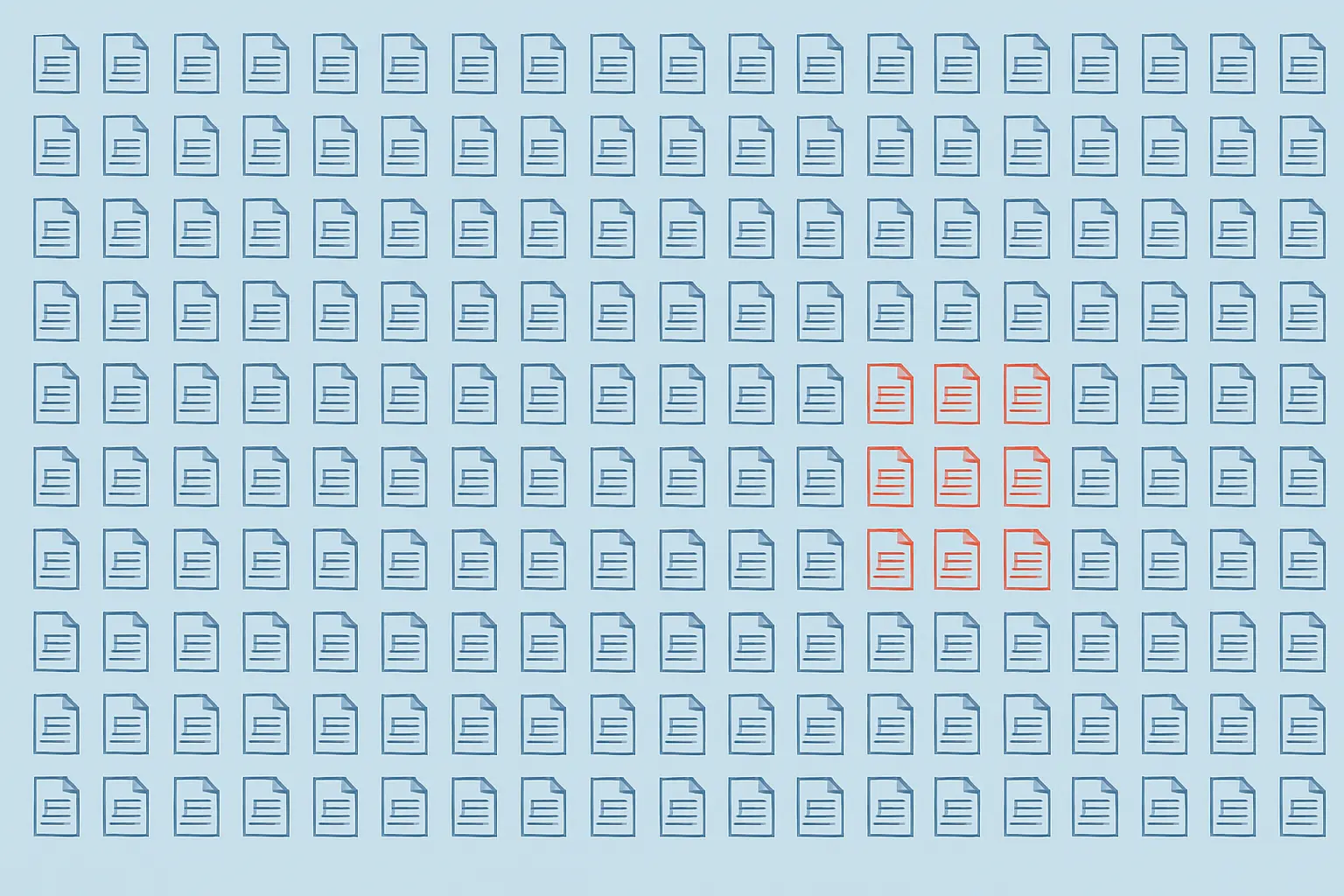
Here is the shape of the indexes these tools read. Using the OpenAlex API on 18 August 2026, works published in 2024 number 10,790,459. Of those, 8,457,431 are in English and 187,315 are in French — that is 1.7%. Narrow to works with at least one author affiliated in Canada in the same year and the total is 183,957, of which 4,338 are in French: 2.4%.
Two cautions, both of which apply to any figure of this kind. The affiliation filter records where an author is employed, not where the research happened. And OpenAlex is one aggregator among several, not the same corpus as Semantic Scholar’s. What the measurement establishes is the shape, and the shape is not in dispute: these indexes are overwhelmingly anglophone.
That matters more in Canada than almost anywhere else, because a Canadian committee may reasonably expect a review to have looked at francophone Canadian scholarship, and because prior Canadian theses are a legitimate and under-used part of the evidence base. Our step-by-step guide to the literature review chapter sets out where those two collections live and how to search them. No tool below does it for you.
1. Semantic Scholar — free, and the layer underneath much of this category
Semantic Scholar is built by a team inside Ai2, a non-profit research institute, and its own about page states that it indexes over 200 million academic papers sourced from publisher partnerships, data providers and web crawls. It is free, it works without an account for search, and it publishes an open API.
Why it ranks first for a thesis: everything it shows you is a record you can open. There is no generated paragraph standing between you and the paper, so there is nothing to fact-check afterwards. For a chapter that a committee will interrogate, that is not a limitation — it is the point.
What it will not do: it will not extract a comparable field from forty papers into a table, and it will not screen for you. If your review is large, you will do that work by hand.
One practical note. Its public API rate-limits aggressively without a key: repeated keyless requests on 18 August 2026 returned HTTP 429 with a pointer to the API key form. If you plan to script anything against it, request a key first.
2. Elicit — the one to pay for, if you are screening at volume
Elicit’s free plan gives unlimited search across more than 138 million papers, unlimited paper summaries, chat with papers where full text is available, and import from Zotero, with limited use of its Research Agent and Research Report features. Paid plans, read from its pricing page on 18 August 2026:
- Plus — US$11 per user per month, billed as US$132 annually. Adds export to RIS, CSV, BIB, PDF and DOCX, five table columns at a time, and search across 500,000 clinical trials.
- Pro — US$39 per user per month billed annually (US$468), or US$49 month to month. Adds a dedicated systematic review workflow that can screen 5,000 papers, twenty columns at a time, reports drawing on up to 135 data sources, ten saved alerts, custom extractions from uploaded papers, and API access.
- Scale — US$89 per user per month billed annually (US$1,068), or US$169 month to month. Adds extraction from figures, live collaboration, and up to 200 data sources.
- Enterprise — custom. Screening at 40,000 papers, SSO and SAML, and the line worth reading twice: “No training on your data by default.”
Read that last bullet as a question about the other plans. A default stated only at the enterprise tier is a default that applies at the enterprise tier. If you intend to upload unpublished chapters or participant material, check the terms attached to the plan you are actually on — the same caution we apply in our comparison of AI tools for thesis writing.
The honest limitation: the table is only as good as the extraction, and the extraction is a model reading a paper. Treat every filled cell as a claim to verify, not as data. Elicit shows its sources for exactly this reason; use them.
3. ResearchRabbit — free, and the best way into a field you do not know
ResearchRabbit says it gives access to over 310 million academic papers and is used by more than a million researchers. It has no published price. Its distinctive move is not answering questions: you seed it with two or three papers you already trust, and it expands outward through citations, co-authors and related work, drawn as a network you can steer.
Why that is useful for a thesis specifically: the hardest part of an early review is not finding papers, it is discovering the term your field actually uses for your concept. A citation graph surfaces that vocabulary, because the neighbouring papers use it. It syncs with Zotero, so what you keep lands in the library you are already citing from — see our comparison of Zotero, Mendeley and EndNote for a Canadian thesis if you have not settled that yet.
The limitation: a citation graph is a popularity structure. Well-cited work pulls the map toward itself, and a recent, unfashionable or francophone study can sit one hop away and never appear. It is a discovery instrument, not a coverage guarantee, and it cannot substitute for a recorded database search.
4. Scite — narrow, expensive, and occasionally decisive
Scite reports 1.6 billion citations across more than 300 million scholarly sources. Its Smart Citation Reports classify how each later paper cited an earlier one, which lets you ask a question no other tool here answers: after this study was published, did the field support it or argue with it?
There is no free tier. Basic is US$20 per month billed yearly and Pro is US$50 per month billed yearly, after a seven-day trial. Its own pricing page says student and academic discounts exist only if you recommend Scite to your institution and copy their sales address on the email.
When it earns the money: when your argument leans hard on one or two foundational studies and you need to know whether the literature has since turned against them. For a defence, discovering that in advance is worth a subscription month. For general searching, it is not.
Two tools I could not verify this week, and will not quote
Consensus and Connected Papers are both widely recommended, and neither could be read on 18 August 2026. consensus.app returned HTTP 403 to a normal browser request and to a second, independent fetching tool, serving a challenge page with sixteen visible characters. Connected Papers’ pricing and FAQ pages return HTTP 200 but render as a client-side shell of about ninety-five visible characters, so no plan or price could be read.
Both may be excellent. What is not defensible is repeating a price from a secondary source and presenting it as checked, so this comparison leaves them out rather than guessing. If you are considering either, open the pricing page yourself and note the date you read it.
What none of them covers, and what to do about it
Four gaps, in the order they will cost you marks:
- Canadian theses. Prior Canadian theses are the closest thing to a worked example of your own genre, and no tool here treats them as a first-class source. Search Theses Canada separately.
- Francophone Canadian scholarship. Érudit carries journals, theses and dissertations, books and research reports in both official languages. Its content will not surface reliably from an English prompt, and the 1.7% figure above tells you why.
- Grey literature. Government, agency and institutional reports rarely carry the metadata these indexes rely on. Federal and provincial sources are covered in our guides to Statistics Canada data and, for legal material, official Canadian legal sources.
- What your library already pays for. Before subscribing to anything, check your library’s licences and your provincial consortium’s discovery layer. Scopus, Web of Science and your discipline’s indexed databases are frequently already bought on your behalf, and a subject librarian will improve your search string in fifteen minutes at no cost.
The permission question, which is not optional
Using one of these tools to find literature and using one to write about it are different acts, and Canadian graduate schools treat them differently. Some require prior approval for any generative use in a thesis, some require a written statement of what was used, and some require both. Get the approval before you start rather than describing it afterwards; the current requirements at the major Canadian graduate schools are set out in our guide to AI use in a Canadian thesis.
The safest working rule: record every search you run — tool, query, date, number of results — in the same table you keep for your database searches. If you are ever asked how you found something, that table is the answer.
The recommendation
Start with Semantic Scholar and ResearchRabbit, both free. Between them they cover the two jobs an early review needs: a searchable index of records you can open, and a map of the citation neighbourhood that teaches you your field’s vocabulary. For most master’s students that is enough.
Add Elicit Plus at US$11 a month, billed annually, when you find yourself extracting the same five fields from forty papers by hand. That is the moment the paid tier pays for itself, and not before. Skip Pro unless you are running a formal systematic review with a screening log to produce.
Add Scite for one month only, near the end, when you want to know whether the field has since disagreed with the studies your argument rests on.
Whatever you use to find the literature, the chapter still has to be argued, structured and defended by you. Draft your literature review in Tesify — the structure and the references stay consistent through every rewrite, while the argument remains 100% yours.
Frequently asked questions
What is the best AI tool for a literature review?
For a Canadian thesis, Semantic Scholar for free searching and ResearchRabbit for free discovery, with Elicit added when you need to extract structured data from many papers at once. No single tool covers the whole job.
Are these tools free?
Semantic Scholar and ResearchRabbit are free. Elicit has a free tier with limited use of its report features. Scite has no free tier, only a seven-day trial.
Can an AI search tool replace a database search?
No. It cannot search what its index does not contain, and it cannot produce the recorded, reproducible search string your committee may ask for. Use it alongside a documented database search, not instead of one.
Will these tools find French-language Canadian research?
Rarely, and not reliably. In 2024, French-language works made up about 1.7% of the year’s output in OpenAlex, and 2.4% of works with a Canada-affiliated author. Search Érudit directly.
Do they find Canadian theses?
Not as a first-class source. Search Theses Canada separately if prior Canadian theses matter to your topic, which in most Canadian programmes they do.
Do I have to declare that I used one?
Often yes. Requirements differ by university and by faculty, and several Canadian graduate schools require prior approval as well as a written statement. Check your own school of graduate studies before you start.
Can these tools invent a citation?
Any tool that generates prose can misattribute a claim to a real paper, which is harder to spot than an invented one. Open every source before it enters your chapter.
Is Elicit worth paying for as a master’s student?
Only once you are extracting comparable fields from dozens of papers. Below that volume the free tier and a spreadsheet do the same work.
What does Scite do that the others do not?
It classifies how later papers cited an earlier one, so you can see whether a study was supported or contradicted after publication rather than only how often it was cited.
Does my university already pay for something similar?
Very likely. Check your library’s database list and your provincial consortium’s discovery layer before subscribing to anything personally.
Should I keep a log of my AI searches?
Yes. Record the tool, the query, the date and the number of results in the same table as your database searches. It costs nothing and it answers the only awkward question you are likely to be asked.