
Short answer: there is no acceptable percentage. No Canadian university publishes a safe threshold, and Turnitin’s own student guide states plainly that “there is no fixed number to receive as a score in your Turnitin Similarity Report.” The percentage measures textual overlap, not misconduct — which is why a 4% score can be a problem and a 38% score can be fine.
The question gets asked in a specific emotional state: it is late, the deposit deadline is near, a number has appeared on a screen, and you want to know whether you are safe. So it is worth saying immediately that the number cannot answer that, and that the people who built it agree.
What does the similarity score actually measure?
Turnitin’s guide for students defines it directly: “The Similarity Score represents the percentage of your writing that is similar to something found on the internet, in our databases, or in someone else’s paper.” Then, in the next sentence: “Similarity does not mean that your work is plagiarized.”
The guide goes on to tell educators what to do about it — “Educators should be considering acceptable forms of similarity, like quotations, citations, and bibliographic material when they review the score.” Every one of those three categories is a legitimate part of a thesis, and every one of them raises your percentage.
That is the whole mechanism. A reference list of 180 entries matches other reference lists. A properly quoted and attributed passage matches its source. The standard phrasing of a methods section — “participants were recruited via purposive sampling” — matches thousands of published papers. None of this is misconduct, and all of it is counted.
Is a low score always good?
No, and this is the part students almost never hear. Turnitin’s own guide lists three things a score can tell you, and two of them are warnings in the opposite direction:
- “A high Similarity Score means that very little of your paper is your own writing.”
- “Zero similarity means that you aren’t including any source-based evidence, a requirement for many assignments.”
- “Some similarity is usually expected.”
A thesis chapter returning 0% is not a clean chapter. It is a chapter with no quotations, no reference list caught in the scan, and possibly no engagement with the literature at all. Examiners notice the second problem long before any software does.
What do the colours in the report mean?
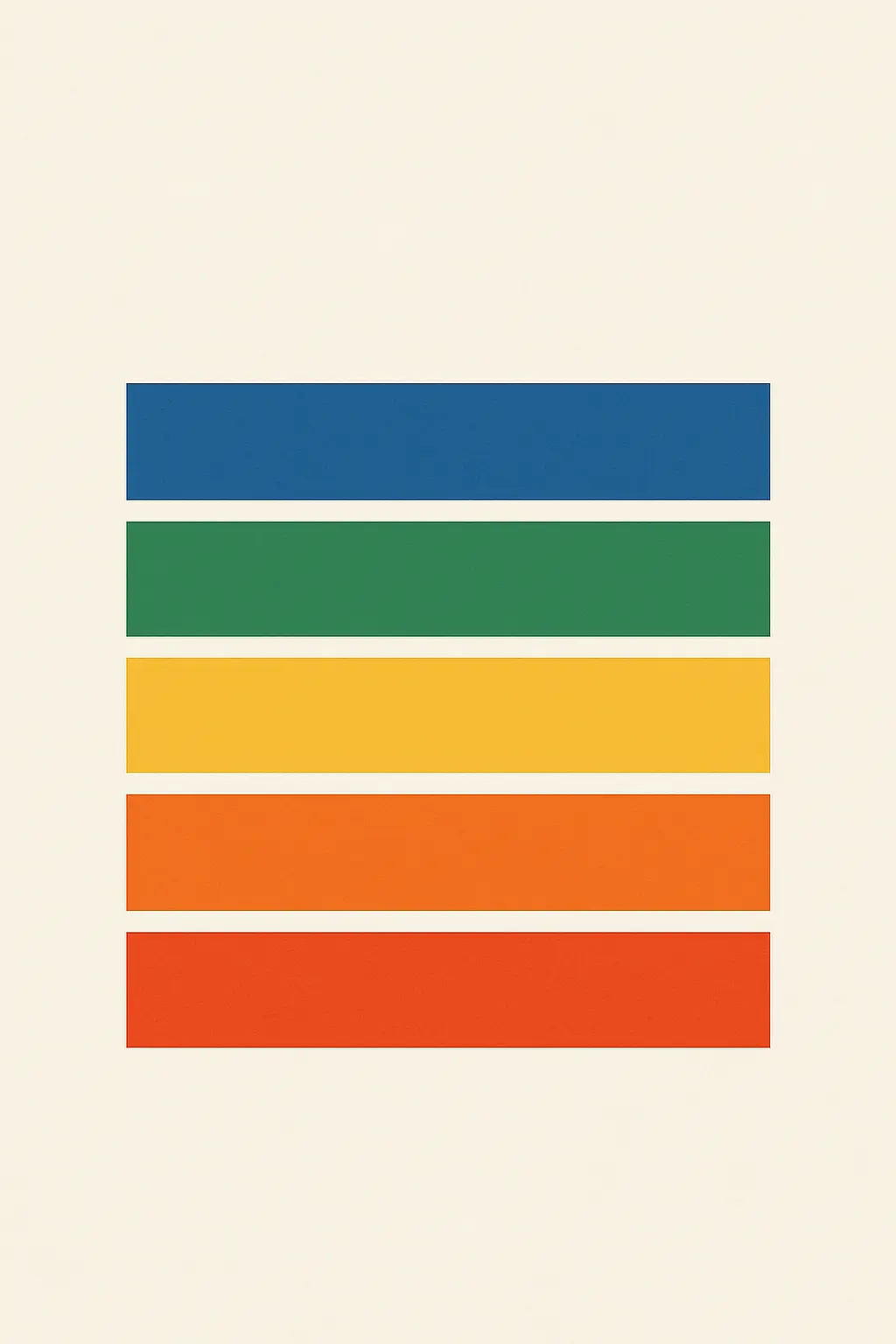
The colour bands are the single most misread element of the report, because they look like a verdict. The University of Toronto’s Centre for Teaching Support & Innovation documents them as follows for the Turnitin Plagiarism Framework:
| Colour | Similarity range | What it actually tells you |
|---|---|---|
| Blue | No matching words | Nothing in the submission matched the index — including, potentially, no citations |
| Green | 1–24% | The most common band for ordinary academic writing with references |
| Yellow | 25–49% | Frequently produced by long block quotations, appendices or a large reference list |
| Orange | 50–74% | Worth opening and reading match by match |
| Red | 75–100% | Usually a structural problem: a template, a duplicate submission, or heavy unoriginal text |
Notice that the bands are ranges of overlap, not ranges of severity. A yellow report on a document with a 40-page appendix of survey instruments is unremarkable. A green report where the whole 12% sits in one uncited paragraph is a genuine problem. The colour cannot distinguish the two; only reading the report can.
What do Canadian universities themselves say?
The clearest Canadian statement comes from the University of Toronto’s teaching guidance, which is unusually blunt: Similarity Reports “do not indicate whether a student has plagiarized.” They help identify sources containing textual similarities in submitted papers, and instructors must use their own judgement to determine whether plagiarism has occurred.
U of T’s academic integrity guidance adds the mechanical detail — “Sections containing material found elsewhere will be flagged by the software, as well as the exact source of the material” — and one procedural right students should know about: if instructors plan to use the plagiarism detection tool for any of their assignments, they must inform their students at the start of the course.
At the University of British Columbia the tool is presented in the same register, as “a plagiarism-prevention tool to determine and check the originality and academic integrity of student submissions,” with the interpretation left to the instructor.
What you will not find at any Canadian institution is a published number. That absence is deliberate, not an oversight.
Do Canadian universities use Turnitin?
Many do. But the answer is less stable than students assume, and the instability has a live consequence in 2026.
The University of Toronto is the instructive case. It moved from Turnitin to Ouriginal on 1 September 2021, then moved back: its teaching guidance notes that Ouriginal “was available before September 2024,” with assignments since then using the Turnitin Plagiarism Framework. Meanwhile Ouriginal no longer exists at all — its own domain now redirects to Turnitin’s site, which states that “Ouriginal service ended on June 30, 2026” and directs former users to Turnitin Similarity.
Two practical consequences follow:
- Institutional pages go stale. At the time of writing, at least one U of T service page still describes Ouriginal as the university’s plagiarism detection tool. The tool it names has been withdrawn. Never take the vendor name from a service page you have not dated.
- Ask, do not assume. The only reliable source for which tool will scan your work is your instructor, your graduate coordinator or your programme handbook for the current term.
It is also worth knowing that the vendor’s own product framing has moved. Turnitin’s current line-up spans Turnitin Clarity, Feedback Studio, Gradescope, ExamSoft, Similarity and iThenticate, with Clarity pitched around understanding AI use rather than only detecting it. The category is drifting from detection towards process visibility, which is a slower-moving version of the same conversation you should be having with your supervisor about what AI use your committee will actually approve.

What should I check instead of the percentage?
Replace the single number with five checks. Each one is answerable by opening the report or your own document.
- Is any single source contributing a large share? Twenty matches of 1% each across twenty papers is normal citation behaviour. One match of 18% against one source is a paragraph you need to look at.
- Are the matched passages quoted and attributed? A match inside quotation marks with a citation is doing its job. A match in unmarked prose is not.
- Is the match your own earlier work? Self-plagiarism rules vary by institution and by programme, and reusing your own coursework in a thesis without permission is a real category of offence at many Canadian universities.
- Is the reference list inflating the number? Ask whether the report you are seeing has bibliography and quotation filters applied; the same document can return very different scores with and without them.
- Does a matched passage survive a paraphrase test? If you could not re-explain the sentence without the source in front of you, it is not yet a paraphrase — it is a copy with synonyms.
The fifth check is the one that matters for a thesis, because patchwriting is what actually gets students into misconduct proceedings, and it is invisible to a percentage. Keeping sources, quotations and citations organised as you write is the cheapest defence there is. Build your chapters in Tesify so quotations stay attributed and your reference list stays consistent while every argument remains 100% written by you.
What if my score is high and I am submitting tomorrow?
Turnitin’s advice to students in this position is unglamorous and correct: choose only the most significant quotes or parts of quotes, summarise or explain ideas in your own words rather than quoting directly, and cite all evidence in the appropriate style. It also tells students to raise concerns with the educator “in a timely manner,” bringing details and data from the paper and the report so the conversation is informed rather than defensive.
That last point is worth taking literally. A student who arrives with the report open, having already identified which three matches are structural and which one is a genuine paraphrase failure, is in a completely different conversation from one who arrives with a number and an apology.
Does any of this differ for a thesis rather than a course paper?
Yes, in two ways. First, a thesis is usually longer and quotation-heavier, so its raw percentage tends to be higher than a term paper’s — and the same instructor judgement applies. Second, the thesis is examined by a committee against your programme’s own integrity rules rather than a syllabus, which is the same structural point that governs editing help and AI use. If you are still deciding what document you are writing in the first place, our guide to the thesis, dissertation and major research paper in Canada sets out how the requirements differ.
And if your work involves human participants, remember that the integrity file and the ethics file are separate — see REB approval and TCPS 2 for the gate that has to clear before the research starts at all.
Frequently asked questions
Is 15% a safe Turnitin score?
There is no safe score. Turnitin states there is no fixed number and directs students to their educator for the school’s acceptable threshold on a given assignment. A 15% score made entirely of cited quotations is different from a 15% score sitting in one uncited paragraph.
What is a good similarity score for a thesis?
No Canadian institution publishes one. Theses tend to score higher than short papers because of reference lists, block quotations and standard methodological phrasing.
Does Turnitin detect plagiarism?
It detects textual similarity. The University of Toronto’s guidance states that Similarity Reports do not indicate whether a student has plagiarised and that instructors must use their own judgement.
Why is my score high when everything is cited?
Because quotations, citations and bibliographic material all register as matches. Turnitin’s guide explicitly tells educators to account for those acceptable forms of similarity when reviewing a score.
Is a 0% score good?
Usually not. Turnitin notes that zero similarity means you are not including source-based evidence, which most assignments require.
Do all Canadian universities use Turnitin?
No. Tools vary by institution and change over time. Confirm the current tool with your instructor or graduate coordinator rather than a service page.
What happened to Ouriginal?
Its service ended on 30 June 2026. The ouriginal.com domain now redirects to Turnitin, which directs former users to Turnitin Similarity. Any syllabus or service page still naming Ouriginal is out of date.
Can I run my own similarity check before submitting?
Sometimes. Some programmes enable a draft or self-check submission; many do not, and third-party checkers differ in what they index. Ask before assuming you will get a preview.
Does the colour of my report decide the outcome?
No. The colours are display bands for ranges of overlap, not a scale of severity. A green report can contain a serious problem and a yellow one can be entirely legitimate.
Does reusing my own earlier essay count?
It can. Self-plagiarism rules vary by institution and programme, and reusing your own submitted work without permission is a recognised offence at many Canadian universities.
Must my instructor tell me the tool is being used?
At U of T, yes — instructors planning to use the plagiarism detection tool must inform students at the start of the course. Check your own institution’s equivalent provision.
What should I bring if I am asked about my report?
The report itself, your draft history, and a short account of which matches are quotations, which are your reference list, and which you have already revised.