
A civil engineering methodology chapter is not one template but four, and most Canadian theses combine two of them: an experimental programme, a numerical or computational model, a field or monitoring study, and a code-based design exercise. State which combination you are running in your first paragraph, then justify every choice against the standard your sub-field actually uses, CSA rather than a generic research-methods textbook.
Step 1: Name your methodology type before you write anything else
Open the chapter with one sentence that tells your committee exactly what kind of study this is. “This study combines a laboratory experimental programme with a validated finite element model” is a defensible opening sentence; “this study uses a quantitative methodology” is not, because it tells a structural or geotechnical examiner nothing about what you actually did.
- Experimental: you fabricate or test physical specimens, concrete cylinders, steel connections, soil samples, in a lab against a recognized test standard.
- Numerical/computational: you build a model, most often a finite element model, and simulate behaviour that would be expensive or impossible to test physically at full scale.
- Field/monitoring: you instrument a real structure or site, a bridge, a slope, a stormwater system, and collect data over time.
- Design-based: you produce a code-compliant design for a structure or system and evaluate it against specified performance criteria.
Most Canadian civil engineering master’s theses pair experimental work with a numerical model that is validated against it, because a validated model lets you run parameter studies a lab budget cannot afford. Say explicitly which pairing you used and why the second method extends what the first alone could show.
The sub-discipline you are working in usually decides the pairing for you. Structural theses lean toward experimental-plus-numerical; geotechnical theses more often pair a field or laboratory soil-testing programme with a numerical model in software such as PLAXIS or FLAC; transportation and municipal engineering theses lean toward field monitoring or a design-based evaluation against a level-of-service or capacity standard rather than a materials test at all. Naming your sub-discipline explicitly in the opening paragraph tells the reader which of these conventions to expect, before they reach your specific method.
Step 2: Cite the codes and standards you are designing or testing against
In Canada, the code you cite depends on your material and your structure type, and you must cite the specific edition, since provisions change between editions and an examiner will ask which one you used.
- Concrete design: CSA A23.3, Design of Concrete Structures, alongside CSA A23.1/A23.2 for concrete materials and test methods.
- Steel design: CSA S16, Design of Steel Structures.
- Overall structural loading and life-safety requirements: the National Building Code of Canada (NBCC 2020), which sets load combinations, seismic and wind provisions that your material-specific code then applies.
- Wood design: CSA O86, Engineering Design in Wood.
- Bridges specifically: the Canadian Highway Bridge Design Code (CSA S6).
Where your test method itself is North American rather than uniquely Canadian, for instance ASTM C39 for the compressive strength of concrete cylinders, cite the ASTM designation alongside the CSA testing standard your lab actually followed, since Canadian labs frequently reference both.
Step 3: Describe your specimens and materials with enough detail to be reproduced
If your study is experimental, this section is where most marks are lost or kept. State the mix design or material source, the specimen geometry and dimensions, the fabrication and curing conditions per CSA A23.1, and the number of replicates per test condition. A sentence like “concrete cylinders were tested for compressive strength” tells an examiner nothing reproducible; a sentence stating cylinder diameter, curing regime, age at testing and the number of cylinders per batch does.
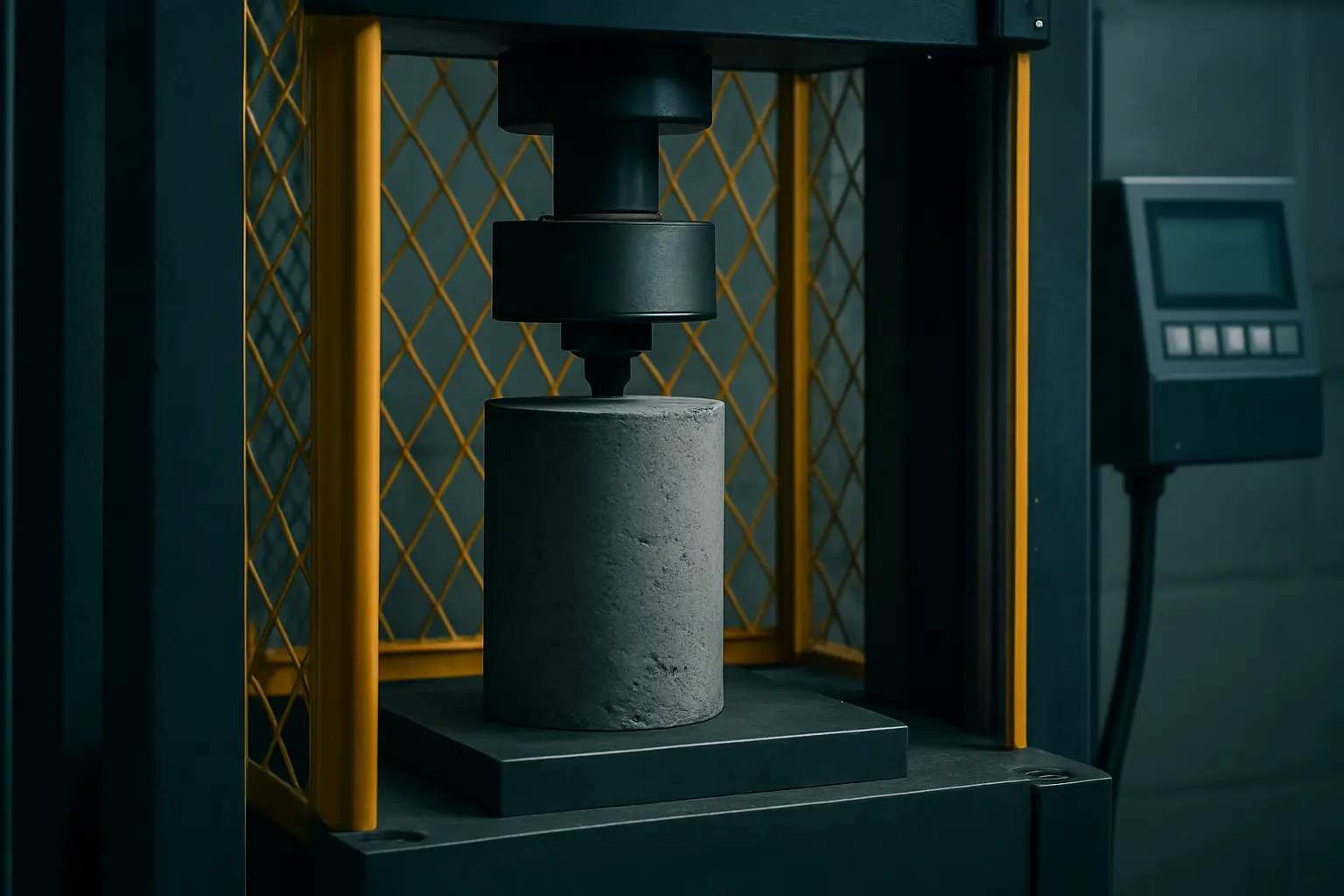
Concrete cylinders (100 mm diameter by 200 mm height) were cast from a single batch and cured in a moist room at 23 °C per CSA A23.1. Three replicate cylinders per test age were tested in uniaxial compression at 7, 28 and 56 days following ASTM C39, using a calibrated 2,000 kN universal testing machine at a loading rate of 0.25 MPa/s.
Step 4: Describe your instrumentation and data acquisition
Name every sensor type, its manufacturer-stated accuracy or resolution where available, its placement, and your sampling rate. Structural instrumentation in Canadian labs and field studies typically draws on some combination of strain gauges bonded to a specimen surface, linear variable differential transformers (LVDTs) for displacement, load cells for applied force, and accelerometers for dynamic or vibration studies. State the data acquisition system and sampling frequency, since a reviewer assessing a dynamic test needs to know whether your sampling rate satisfies the Nyquist criterion for the frequencies you are trying to capture.
Field and monitoring studies add a further requirement: report the monitoring duration, the environmental conditions during data collection, and how you handled sensor drift or missing data over the monitoring period, since a bridge or slope instrumented for six months will accumulate gaps that a lab test never has to address.
Calibration belongs in this section too, and it is frequently skipped. State when each sensor was last calibrated, against what reference standard, and what the manufacturer-stated or lab-verified accuracy was at the time of testing. A strain gauge or load cell without a stated calibration history is a measurement an examiner cannot evaluate for trustworthiness, regardless of how clean the resulting data plot looks.
Step 5: Describe your numerical model, if you are running one
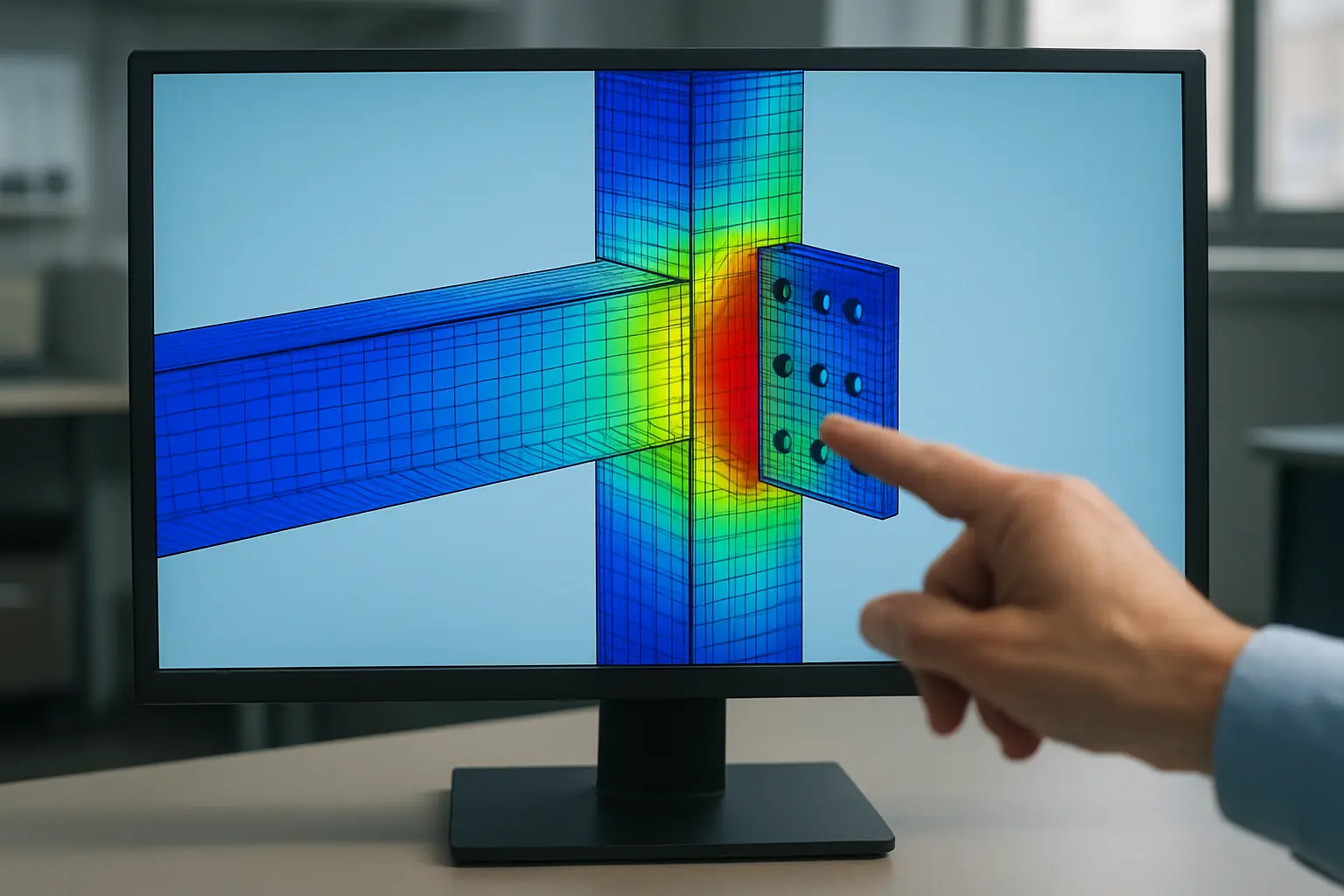
State the software (ABAQUS, ANSYS, SAP2000, ETABS and the open-source OpenSees are all standard in Canadian civil engineering programs), the element type and formulation, the material constitutive model, and the boundary and loading conditions. Then report a mesh convergence study: run the model at two or three progressively finer mesh densities and show that your result of interest, deflection, stress, natural frequency, stabilizes as the mesh refines. Without a convergence study, a numerical result is a number with no evidence behind it, and it is the single most common gap examiners flag in a civil engineering methodology chapter.
Step 6: State your validation strategy explicitly
A model is not credible because it runs; it is credible because you showed it reproduces something already known. Validate against your own experimental data where you have it, against a closed-form or code-predicted value where you do not, or against a published benchmark case from the literature. State the acceptable error tolerance you are using, commonly within 5 to 10 per cent for well-characterized structural behaviour, before you run the comparison, not after you see how close the numbers came.
- Run the model under the exact conditions of your experimental or benchmark case.
- Compare the model output against the reference value using a stated metric, per cent difference or root-mean-square error.
- State whether the result falls inside your pre-declared tolerance, and if not, revise the model and report what changed.
- Only once validated do you proceed to the parameter study your thesis is actually about.
Step 7: State your limitations honestly, by methodology type
Every civil engineering methodology has a limitations paragraph specific to its type. An experimental programme is limited by specimen scale, since lab-scale specimens do not always capture full-scale behaviour; state whether your specimens are full-scale, reduced-scale, or scaled per a similitude law, and what that implies. A numerical study is limited by its assumptions, linear versus nonlinear material behaviour, perfect bond assumptions, idealized boundary conditions, that a real structure will not satisfy exactly. A field study is limited by the specific site and loading history you observed, which may not generalize to other structures. State these plainly rather than in a single generic sentence at the very end of the chapter.
Step 8: Address safety, sustainability and Canadian professional practice
Most civil engineering theses do not require Research Ethics Board approval, since testing concrete or running a finite element model involves no human participants; approval becomes relevant only if your study surveys building occupants, infrastructure users or practising engineers, in which case the process is the same one covered in the guide to REB approval and TCPS 2 rules in Canada. What every Canadian civil engineering thesis does need is a documented lab safety protocol for the specific hazards involved, testing machines under load, chemical curing agents, confined-space field access, and a statement that the work was conducted under the supervision of a licensed professional engineer where required by your province’s engineering act.
Sustainability criteria increasingly belong in the methodology itself rather than only the discussion: if your thesis compares material or design alternatives, state whether you are also evaluating embodied carbon, recycled content, or compliance with a rating system such as LEED or the Canada Green Building Council’s Zero Carbon Building Standard, since accredited programs increasingly expect this as a stated evaluation criterion, not an afterthought.
How does this compare to methodology decisions in other fields?
The logic of stating your design before your data, naming the standard you are held to, and validating before you interpret is common across engineering and science disciplines, though the specific standards differ. An environmental science thesis working with spatial and remote-sensing data faces an analogous software decision, covered in the comparison of GIS software for an environmental science thesis, and once your experimental data are collected, the statistical package you analyze them in is its own decision, laid out in the comparison of statistics software for a Canadian thesis. A computer science thesis validating a system rather than a structure follows the same convergence-then-validate logic under a different name, covered in the guide to how to structure a computer science thesis.
Can Tesify help you write the methodology chapter?
Choosing between an experimental programme, a validated numerical model and a field study is an engineering judgment only you and your supervisor can make, but writing the specimen description, the convergence-study paragraph and the limitations section in the precise, code-cited register your committee expects is exactly the drafting work Tesify is built to help with.
Draft your methodology chapter with Tesify
Frequently asked questions
Do I need both an experimental programme and a numerical model?
No. A single method is entirely acceptable if it answers your research question on its own. Pairing them is common because a validated model extends a limited lab budget into a wider parameter study, not because two methods are inherently more rigorous than one.
Which edition of a CSA standard should I cite?
The edition current when you designed your study or ran your tests, stated explicitly with its year. If a new edition is published while you are writing, note the change in a footnote rather than silently switching, since your calculations were performed under the earlier edition.
How many replicate specimens do I need per test condition?
Three is the conventional minimum in most Canadian civil engineering labs, enough to report a mean and a coefficient of variation, though your supervisor or the specific ASTM or CSA test method may specify more for particular tests.
What counts as an acceptable mesh convergence result?
Your result of interest should change by less than a stated small percentage, commonly under 2 to 5 per cent, between your two finest mesh densities. Report the actual percentage change rather than simply asserting that convergence was achieved.
Do I need to validate my numerical model against my own experimental data?
It is the strongest option where you have it, but validating against a published benchmark case or a code-predicted closed-form value is an accepted alternative when running your own experiment is not feasible within your thesis timeline.
Is a design-based thesis with no testing or modelling acceptable?
Yes, at many Canadian programs, provided the design is evaluated against explicit, stated performance criteria and code provisions rather than presented as a design exercise with no evaluation at all.
Do I need a professional engineer to supervise lab testing?
Your academic supervisor’s credentials and your provincial engineering act govern this, and requirements vary by province and by whether the work will inform a stamped design; confirm the specific requirement with your department before you begin fabrication or testing.
How do I handle a specimen or sensor that failed during testing?
Report it. State what failed, when, and how you handled the resulting data, excluded, flagged, or replaced, rather than omitting the failure silently. Examiners routinely ask about anomalies they can see in a results table, and an undocumented gap reads worse than an honestly reported one.