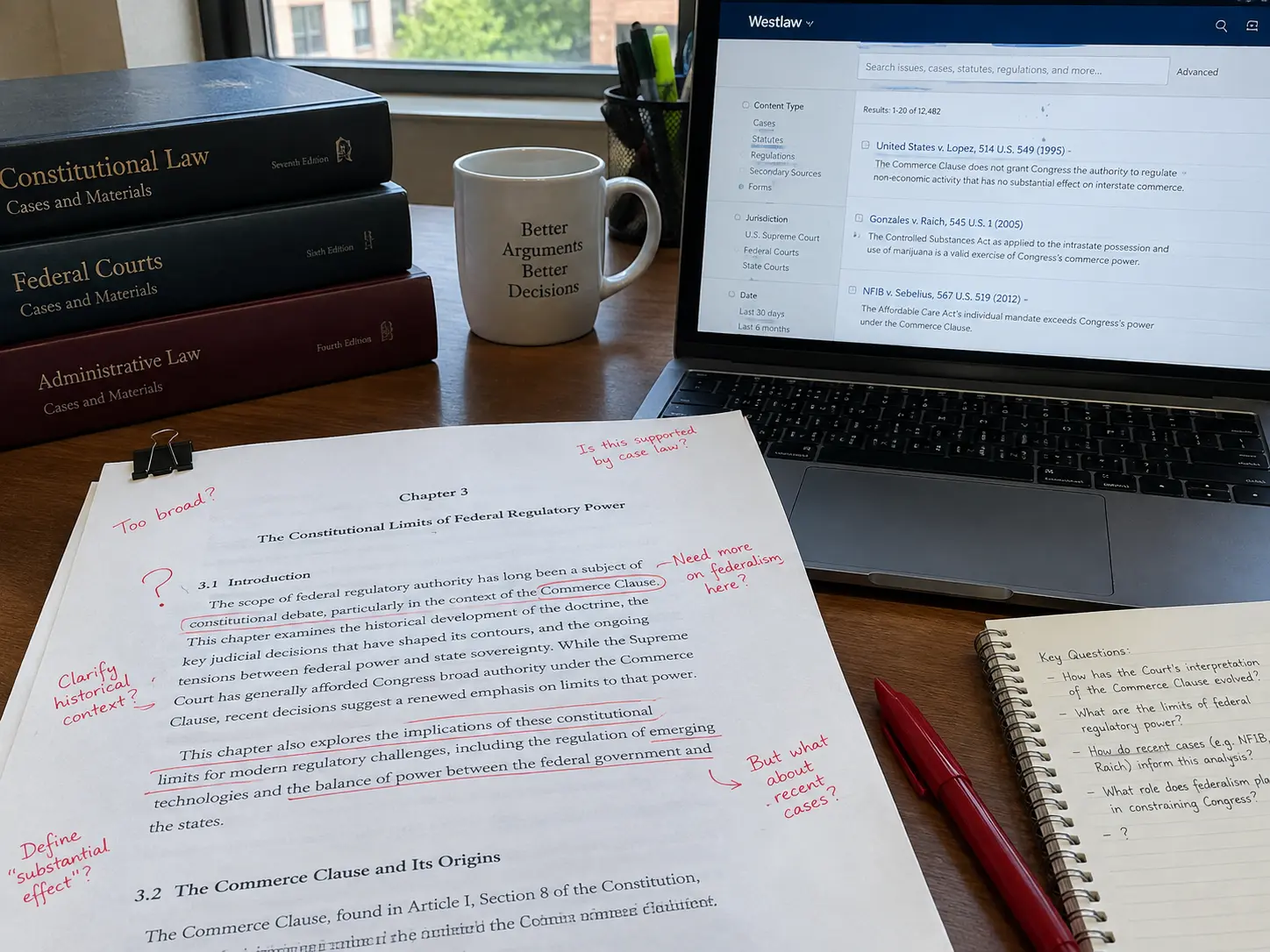
Law theses are commonly sent back for four recurring reasons: a thesis question that is really a topic, not an argument; case law cited without checking whether it is still good law; a structure that describes the law instead of building a position; and objections the writer never addressed because they never imagined a reader who disagreed. Each is fixable before your committee sees the draft, not after.
Why is a “topic” not the same as a thesis question?
An examiner’s first objection is often the most basic: “what is this thesis actually arguing?” A title like “Privacy Law and Artificial Intelligence in Canada” describes a subject area, not a claim — it could become a dozen different theses, each defending a different position, and a committee cannot evaluate an argument that has not yet been stated as one. The fix is to compress your project into a single sentence that could be true or false. An illustrative example: “Canadian privacy law’s consent-based framework fails to adequately protect individuals from AI-driven inference, and should be supplemented by a purpose-limitation requirement.” That sentence is arguable, falsifiable, and gives your reader something concrete to evaluate — a topic gives them nothing to push back on, which paradoxically makes it harder to defend, not easier.
Why does citing case law without checking its current status trigger a rejection?
Few things undermine a law thesis faster than an examiner discovering, mid-defence, that a case central to your argument was overturned, distinguished into irrelevance, or superseded by a later statutory amendment you did not mention. This is not a minor citation slip — it signals that your research process itself is unreliable, and an examiner who catches one instance will start distrusting every other case you cite, even the ones that are still good law. Before you finalize any chapter, run every case you rely on through a citator or a current case-law database to confirm its subsequent judicial history, and note explicitly in your text when a case’s status has shifted since an earlier commentator wrote about it — that explicit acknowledgment is itself evidence of rigour, not a weakness to hide.

Why does “describing the law” read as weaker than it should?
A thesis chapter that walks through a statute section by section, or summarizes what several cases each decided, is doing legal research — but it is not yet doing legal argument, and examiners notice the difference immediately. The objection usually sounds like “this chapter tells me what the law is, but not what you think is wrong with it, or right about it, or how it should change.” The fix is structural: every descriptive paragraph about what the law currently says should be followed by an evaluative paragraph about what that means for your argument — a gap it leaves, a tension it creates with another area of law, or a consequence it produces that your thesis is built to address. If you can delete a paragraph and your argument loses nothing, that paragraph was description, not argument, and it is a strong candidate to cut or fold into a footnote.
Why does failing to address the counter-argument cost so much at defence?
An examiner’s job is partly to test whether you have anticipated the strongest objection to your own position, not just the weakest one. A thesis that only engages with authors who agree with it, or that mentions an opposing view only to dismiss it in a single sentence, reads as either unaware of the counter-argument’s real strength or unwilling to engage with it honestly — both readings damage your credibility more than simply losing the point would. Identify the single strongest objection a well-informed critic could raise against your central claim, state it as fairly and as strongly as that critic would state it themselves, and then respond to it directly. A thesis that survives its own best counter-argument is far harder to dismantle at a defence than one that never let the counter-argument speak.

Why do outdated statutory references sink an otherwise strong thesis?
Statutes and regulations change, sometimes mid-way through a thesis’s writing period, and a citation to a repealed or amended provision reads to an examiner exactly like an overturned case: a signal that your final research pass happened too early. Before your final submission, re-check the current consolidated version of every statute and regulation you rely on, not just the version you first read when you started the chapter months earlier — a provision renumbered or amended since your literature review began is a common, avoidable error that a five-minute check catches.
Why does an unclear methodology chapter draw objections even in a doctrinal thesis?
Many examiners expect a law thesis, even a purely doctrinal one, to state explicitly how sources were selected and why — which jurisdictions were compared and which were excluded, which time period the case-law review covers, and what counts as “sufficient” engagement with a body of scholarship. A thesis that simply asserts conclusions without describing how it arrived at them invites the objection that its selection of sources was convenient rather than systematic. State your method plainly, even in a single paragraph: the databases searched, the jurisdictions compared, the cut-off date for currency, and the criteria that decided what made the final argument and what did not.
Why does inconsistent formatting or citation style draw objections that feel unfair?
It rarely sinks a thesis on its own, but inconsistent citation formatting compounds every other objection above: an examiner already questioning whether your case-law currency checks were thorough reads a sloppy citation as further evidence of a rushed final pass, even when the underlying research was careful. Canadian universities each publish their own formatting specifics, and a consistent citation style applied to every reference, checked once at the very end rather than as you go, removes this objection from the table entirely — it costs an afternoon and prevents a distraction that has nothing to do with the strength of your argument.
Why does an unclear scope draw the same objection twice, at proposal and at defence?
A thesis that promises to cover “Canadian administrative law” but only actually examines two agencies in one province will be asked, at both the proposal stage and the defence, why the scope stated in the introduction does not match the scope actually delivered in the chapters. This is a different objection from the topic-versus-argument problem above: the argument can be sharp and well-stated while the stated boundaries of the project are simply wrong. State your scope precisely in the introduction — which jurisdiction, which time period, which specific bodies of law or institutions — and then audit your finished chapters against that exact statement before submission. A narrower, accurately stated scope reads as more rigorous than an ambitious one the thesis does not actually deliver.
A quick self-check before you submit a chapter
Before sending a chapter to your supervisor, ask four questions in this order: can I state my argument, not my topic, in one sentence? Have I confirmed the current status of every case and statute I rely on? Does every descriptive paragraph earn its place by feeding an evaluative point? And have I stated the strongest version of the objection to my own position, not the weakest? A chapter that passes all four is far more likely to survive a first read by your supervisor without a “this needs more work” note attached.
Where this connects to the rest of your thesis
A thesis question stated as a genuine argument, per the first objection above, is also the foundation a strong research proposal needs — a full law-thesis research-proposal document, built around a worked example, shows how that argument gets translated into a proposal a committee approves. And if your case-law and statutory currency checks above turn up gaps in your own search process, how to do legal research using official Canadian sources covers finding the current, authoritative version of a statute or judgment at the primary source rather than an aggregator that may be out of date. The same discipline — matching your access and your method to what you can actually verify — is not unique to law: it shows up just as clearly in how a social work thesis on a sensitive population has to match its research question to a realistic access route before a committee will approve it.
Where Tesify fits
Catching a weak counter-argument section or an unclear structural gap is easier with a second read than with your own tired eyes after the fifth revision. Tesify helps you draft and revise your chapters in your own words, from your own research, structured to hold up against exactly these kinds of examiner objections. See how it works at app.tesify.app.
Frequently asked questions
What is one of the most common reasons a law thesis gets sent back?
A thesis question that is really a topic, not an arguable claim — the committee cannot evaluate an argument that has not yet been stated as one, so this is often flagged before any other issue.
How do I check if a case I’m relying on is still good law?
Run every central case through a citator or current case-law database to confirm its subsequent judicial history before finalizing a chapter, and note explicitly in the text if a case’s status has changed since an earlier source discussed it.
What’s the difference between describing the law and arguing about it?
Description tells the reader what the law currently says; argument tells them what that means, what gap it leaves, or what should change. If deleting a paragraph costs your argument nothing, it was description.
Do I need to address arguments against my own position?
Yes. State the single strongest objection a well-informed critic could raise, as fairly as that critic would state it, and respond to it directly — a thesis that survives its own best counter-argument is much harder to dismantle at a defence.
Why would an examiner object to an outdated statutory citation?
It signals your final research pass happened too early. Re-check the current consolidated version of every statute and regulation before final submission, not just the version you first read when the chapter was drafted.
Does a doctrinal thesis need a methodology section?
Often, yes. State plainly which databases you searched, which jurisdictions you compared, your currency cut-off date, and what criteria decided what made the final argument — this pre-empts the objection that your sourcing was convenient rather than systematic.
Does inconsistent citation formatting actually matter if my argument is strong?
It rarely sinks a thesis alone, but it compounds every other objection — an examiner already questioning your rigour reads sloppy citations as further evidence of a rushed final pass. A single consistency check at the end removes this distraction entirely.
Why would my scope be questioned if my argument itself is sound?
Because the argument and the stated scope are two different things a committee checks separately — a thesis that promises broad coverage but delivers a narrower study will be asked why the introduction and the chapters don’t match, even if the argument inside that narrower study is strong.
What four questions should I ask before submitting a chapter?
Can I state my argument, not my topic, in one sentence? Have I confirmed the current status of every case and statute? Does every descriptive paragraph feed an evaluative point? Have I stated the strongest version of the objection to my own position?
Can Tesify help me structure my chapters to avoid these objections?
Tesify helps you draft and revise chapters in your own words, from your own research, structured to hold up against exactly these kinds of examiner objections.