
Step 1: Understand that a hospital or clinic is a second gatekeeper, not just a data source
A psychology thesis that recruits participants or accesses records inside a hospital, clinic or health authority is not simply choosing a convenient population — it is entering an institution with its own governance, its own timeline, and its own approval process that sits alongside, not instead of, your university’s Research Ethics Board (REB) review. Students who treat “get REB approval” as the only hurdle are often surprised months later when the hospital’s own research office asks for a separate application, a separate privacy review, and sometimes a separate ethics review specific to that institution — on its own schedule, which your university’s REB timeline does not control. Planning for this second layer from the very first draft of your proposal, rather than discovering it after REB approval is already in hand, is one of the most important things you can do to keep a hospital-based thesis on schedule.
Step 2: Map the two (or three) approvals you actually need
Start by identifying, in writing, every institution whose approval your study requires: your university’s REB, certainly; the hospital or clinic’s own research ethics board or research office, if it maintains one separately from your university’s; and, if your study spans more than one site, a multi-site or streamlined review mechanism. In Ontario, for example, Clinical Trials Ontario runs a streamlined research ethics review program, through its CTO Stream platform, that lets all sites participating in a multi-site study undergo a single ethics review rather than applying separately to each local research ethics board — a purpose-built mechanism for exactly this coordination problem, worth researching early if your study touches more than one Ontario institution, rather than assuming each site’s REB will run an independent full review on its own separate timeline. Confirm with your supervisor and the hospital’s own research office, at the very start of your proposal stage, exactly which approvals your specific study needs — this varies by institution and by whether the hospital is academically affiliated with your university or operates independently.
Step 3: Budget real time for the operational approval, separately from the ethics approval
Ethics approval answers whether your study is ethically sound; operational or institutional approval answers whether the specific hospital or clinic is willing and able to host it — do they have the clinical space, the staff time, the patient population, the IT and privacy infrastructure your study needs? These are different questions, reviewed by different people, often on different timelines, and a hospital’s operational approval can take as long as or longer than the ethics review itself, particularly if your study requires clinical staff time or access to a hospital’s electronic health record system. Build both timelines into your proposal from the start, with realistic estimates from your own supervisor or a prior student who has worked with the same institution, rather than assuming ethics approval alone means you can begin data collection.
Step 4: Get data ownership and access terms in writing before you start
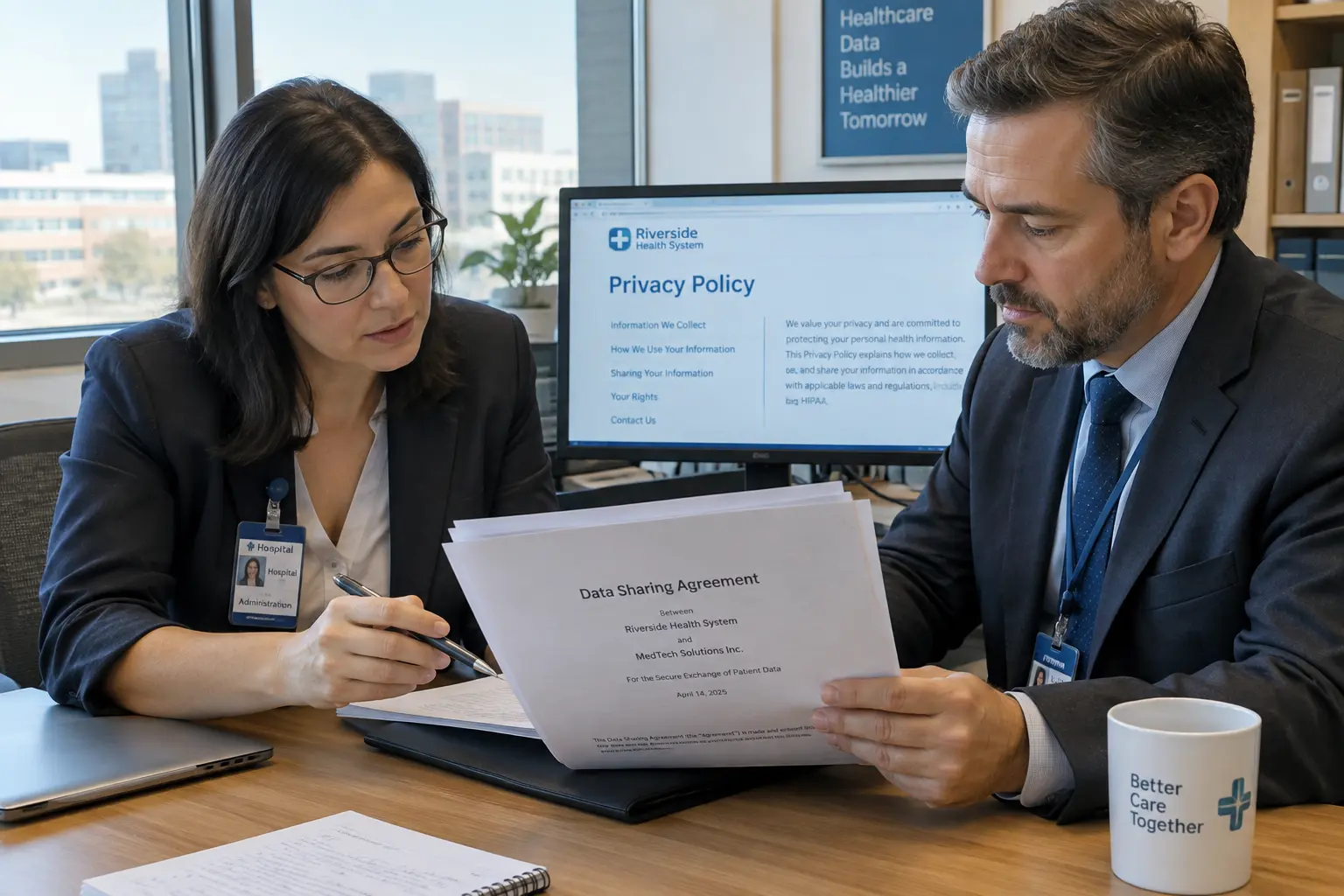
Who owns the data your study generates — you, your university, or the hospital — and who can access it after your thesis is complete are questions a data-sharing or data-access agreement should answer explicitly, in writing, before data collection begins, not assumed informally. This matters especially for any data drawn from a hospital’s own clinical records or systems: the hospital’s privacy office will typically require its own data-sharing agreement specifying exactly what you can extract, in what de-identified or aggregate form, and what happens to that data after your thesis is deposited. Raise this question directly with your supervisor and the hospital’s research office early, and get the answer in writing rather than assuming the terms will simply work themselves out once data collection is underway.
Step 5: Design your study around the access you can realistically negotiate
A study that requires embedding yourself in a hospital unit for months of direct observation is a fundamentally different access proposition than a study using de-identified administrative data the hospital already collects for other purposes, or a study recruiting through a clinic’s waiting room with staff assistance rather than direct clinical involvement. Rank your access options by how much they ask of hospital staff time and clinical space, and favour the design that asks for less unless your research question genuinely requires deeper access — a study is not weaker for choosing the access route that is actually available to you within a normal thesis timeline.
Common mistakes that cost students a full term
The most expensive mistake is treating REB approval as the finish line: students who begin recruitment or data collection the moment their university REB clears, without confirming the hospital’s own operational sign-off is also in place, can end up having to halt a study mid-stream when the hospital’s research office discovers activity it never separately approved. A second is underestimating how much staff time a design actually asks for — a “quick 15-minute survey” administered by already-stretched clinical staff during a busy shift is a much bigger operational ask than it sounds on paper, and hospital research offices weigh exactly this kind of burden. A third is failing to name a specific contact inside the hospital before submitting a proposal to your own supervisor — a proposal that says “I will seek hospital approval” without a named research-office contact or department reads as a plan that has not yet tested whether the access is real.
A worked example of framing a realistic study
Illustrative, fictional example: a student wants to study whether a brief mindfulness intervention reduces reported anxiety among patients waiting for a specialist appointment at a hospital outpatient clinic. Framed as a study requiring the student to deliver the intervention personally, in clinical space, to patients recruited by clinical staff, the access negotiation involves clinical scheduling, staff training, and space allocation that can extend well past a typical thesis timeline. Reframed as a study using an already-existing, hospital-run mindfulness program (if one exists) and collecting only a brief pre/post survey from consenting patients already enrolled in that program, the same underlying question becomes answerable with a much lighter operational footprint — less staff time requested, a narrower data-sharing agreement, and a correspondingly faster path through both ethics and operational approval.
A proposal self-check before you submit to your supervisor
Before sending an access-dependent proposal forward, confirm you can answer four questions concretely, not aspirationally: who, by name or role, is your contact inside the hospital or clinic, and have you actually spoken with them? What exactly are you asking of clinical staff time, in minutes or hours per participant, and does that number sound sustainable to someone who has never met you? Where does the data live after collection, and who besides you can see it? And what is your realistic fallback design if the operational approval takes longer than your thesis timeline allows, or is denied outright? A proposal that can answer all four moves through your supervisor’s review far faster than one that treats institutional access as a detail to be worked out later.
How this connects to other work on this site
The REB approval process itself, including what TCPS 2 requires and exempts, is covered separately — whether your thesis needs Research Ethics Board approval walks through that question in full; this article covers what happens after REB approval is the easy part and the harder work is the institution’s own separate operational sign-off. The population-access challenge described here is not unique to psychology — a social work thesis on youth in foster care faces a strikingly similar two-layer approval structure with a different gatekeeper (a child welfare agency instead of a hospital), and the same lesson about designing your study around realistic access applies in both fields. And once your access route and population are settled, the instrument comparison for a psychology thesis is the natural next step.
Where Tesify fits
None of the access and data-ownership negotiation above can be shortcut by a writing tool, but once your access plan is settled, Tesify helps you draft and structure the proposal itself — the literature review, the methodology chapter, the ethics and data-access sections — in your own words, from your own research. See how it works at app.tesify.app.
Frequently asked questions
Do I need both my university’s REB approval and the hospital’s own approval?
Usually yes, if your study involves the hospital’s patients, staff or records. University REB approval and the hospital’s own research ethics or operational approval are typically separate processes, on separate timelines, and one does not substitute for the other.
What is Clinical Trials Ontario’s streamlined review system?
A program, run through the CTO Stream platform, that lets all sites participating in a multi-site study in Ontario undergo a single ethics review rather than applying separately to each local research ethics board — worth researching early if your study touches more than one Ontario institution.
What’s the difference between ethics approval and operational approval?
Ethics approval asks whether your study is ethically sound; operational approval asks whether the specific hospital or clinic can actually host it — the clinical space, staff time, and infrastructure your study needs. They are reviewed separately and can run on different timelines.
Who owns the data my study collects inside a hospital?
This should be answered explicitly in a data-sharing or data-access agreement, in writing, before data collection begins — raise the question directly with your supervisor and the hospital’s research office early rather than assuming.
How should I choose between a deep-access design and a lighter-access design?
Rank your access options by how much they ask of hospital staff time and clinical space, and favour the lighter option unless your research question genuinely requires deeper access — a lighter design that is actually achievable beats an ambitious one that stalls in operational approval.
How long should I budget for a hospital’s operational approval?
Get a realistic estimate from your supervisor or a prior student who worked with the same institution — operational approval can take as long as or longer than the ethics review itself, especially if you need clinical staff time or electronic health record access.
What is the most common mistake students make with this kind of access?
Treating REB approval as the finish line and beginning recruitment or data collection without confirming the hospital’s own separate operational sign-off is also in place — a study can be halted mid-stream when a hospital research office discovers unapproved activity.
What four questions should my proposal answer before I submit it to my supervisor?
Who is your named contact inside the hospital, and have you spoken with them? What exactly are you asking of clinical staff time? Where does the data live afterward and who can see it? And what is your fallback design if operational approval is delayed or denied?
Can I reframe a hard-to-access study into an easier one?
Often, yes. A study requiring you to personally deliver an intervention in clinical space is a much harder access proposition than a study collecting a brief survey from patients already enrolled in an existing hospital program — the same research question can sometimes be answered either way.
Can Tesify help me write the ethics and data-access sections of my proposal?
Tesify helps you draft and structure your proposal’s literature review, methodology and ethics sections in your own words, once your access plan and question are settled.