
A researchable political science question names a specific relationship between defined political actors, institutions, or variables, in a defined time and place — not a broad topic. “Why do coalition governments form?” is a topic. “Under what conditions did Canadian federal minority governments since 2004 seek formal coalition versus confidence-and-supply arrangements?” is a question you can actually answer with evidence. A hypothesis then states the specific, falsifiable relationship you expect to find.
What makes a research question “researchable” in political science?
A political science examiner checks a proposed research question against four tests before anything else gets discussed:
- Specificity. Does it name a particular institution, actor, policy, or event rather than a general phenomenon?
- Boundedness. Does it specify a time period and jurisdiction you can actually cover with the evidence available to you?
- Answerability. Can existing data, documents, or interview access actually let you answer it, or does it require information you cannot obtain (classified Cabinet documents, private party records)?
- Disciplinary contribution. Does answering it add something the existing literature does not already establish, or would your answer just confirm settled knowledge?
A question that fails the boundedness test is the single most common reason a proposal comes back for revision — “how does populism affect democracy” needs a country, a party or movement, and a time window before a committee will approve it. Once your question passes these tests, it belongs at the top of your methodology chapter, stated in exactly the same words it appears in your introduction.
What is the difference between a research question and a hypothesis in political science?
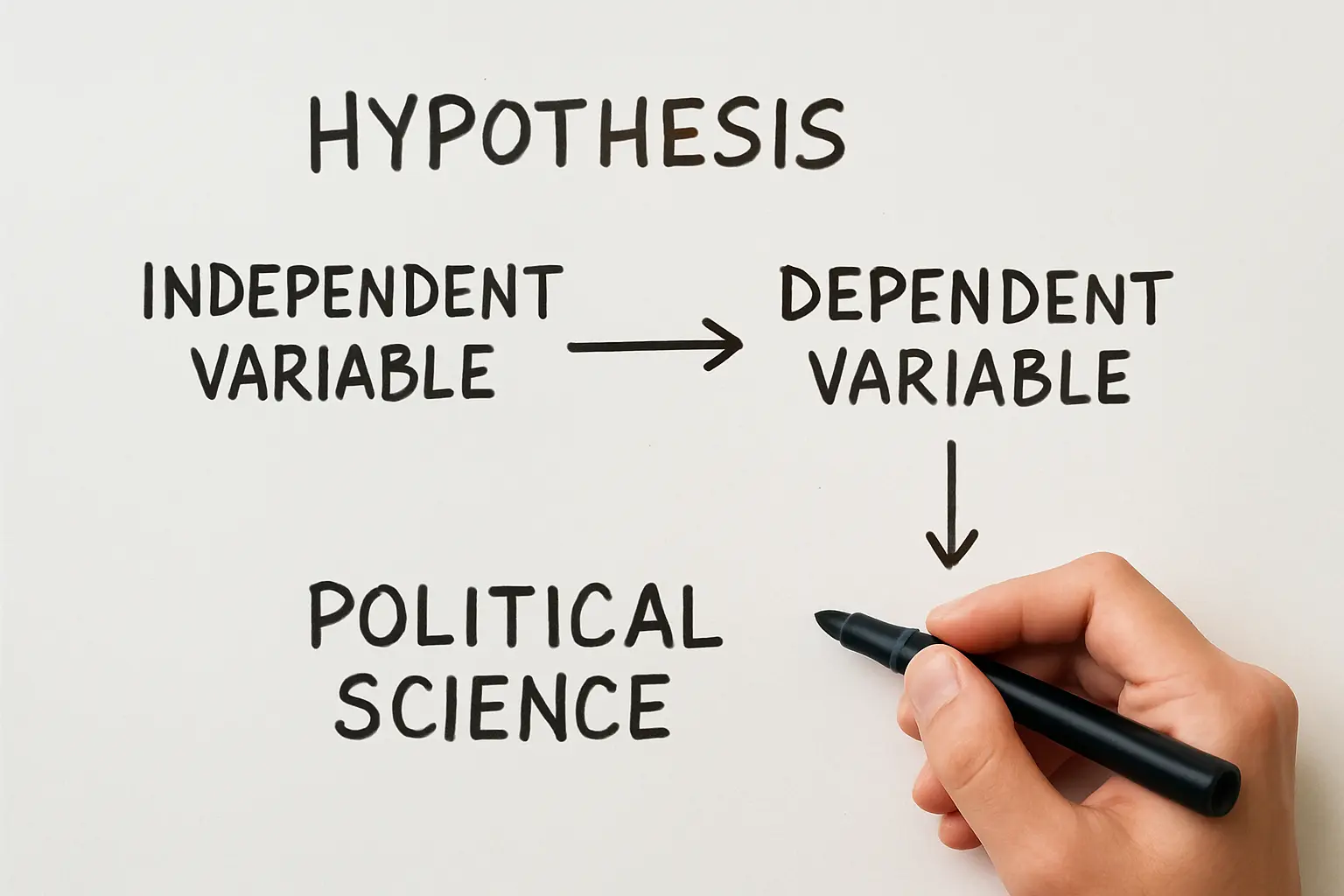
The research question states what you are investigating; the hypothesis states what you expect to find and why, in a form that could turn out to be wrong. Not every political science thesis needs a formal hypothesis — interpretive, historical-institutionalist, and discourse-analytic theses often work from a research question and a set of analytic expectations instead. Quantitative and most comparative-case-study theses do need one. A workable hypothesis names the independent variable, the dependent variable, and the direction of the expected relationship: “Provinces with proportional representation electoral systems (independent variable) will show higher voter turnout (dependent variable) than provinces using first-past-the-post, because proportional systems reduce the perceived cost of a wasted vote.” Note the causal mechanism stated at the end — a hypothesis without a stated mechanism reads as a correlation guess, not a theory-driven claim.
Worked examples by sub-field
The good research question looks different depending on which part of the discipline you are working in:
- Canadian politics: “Did the 2015 shift to gender-balanced federal Cabinet appointments change the substantive policy priorities pursued by ministers with intersecting portfolios, compared with the preceding two Cabinets?” — bounded to a specific institutional change, comparable across a defined time window.
- Comparative politics: “Why did British Columbia and Ontario adopt different cap-and-trade versus carbon-tax approaches to provincial climate policy between 2008 and 2018, despite similar public opinion on climate action?” — a most-similar-systems comparison with a clearly stated puzzle (similar inputs, different outputs).
- International relations: “How did Canada’s positioning within NATO’s Arctic security discussions shift between the 2014 Wales Summit and the 2022 Madrid Summit, and what domestic political factors explain the timing of that shift?” — names the institution, the specific summits as bounding events, and the causal factor of interest.
- Political theory: “Does Charles Taylor’s account of recognition provide adequate conceptual resources for evaluating Canada’s duty-to-consult jurisprudence, or does it require modification to address collective rather than individual claims?” — a conceptual, argument-driven question rather than an empirical one, still specific about the theorist, the case, and the precise conceptual gap being tested.
- Public administration: “Did the introduction of gender-based analysis plus (GBA+) requirements to federal budget submissions after 2018 change the substantive content of departmental spending proposals, or only their documentation?” — distinguishes a formal-compliance outcome from a substantive-policy outcome, a distinction public administration examiners specifically look for.
- Indigenous politics: “How have self-government agreements negotiated under the federal Comprehensive Land Claims policy since 2000 differed in their treatment of resource-revenue sharing, compared with agreements negotiated in the 1990s?” — names the specific policy instrument, a comparison across two negotiating periods, and a defined substantive dimension (revenue sharing) rather than treating “self-government” as a single undifferentiated category.
Notice what all six examples share: a named institution or policy instrument, an explicit comparison or time bound, and a stated outcome variable. A question missing any one of those three elements is the version examiners send back for narrowing.
Common mistakes political science committees see repeatedly
- The “everything” question. A question broad enough to require a multi-year, multi-country research program rather than a thesis-length answer.
- The unfalsifiable hypothesis. A hypothesis worded so vaguely that almost any finding could be read as confirming it.
- The undefined key term. Using a contested concept — “populism,” “democratic backsliding,” “polarization” — without stating which scholarly definition you are operationalizing and how you will measure it.
- Level-of-analysis slippage. Drawing individual-level conclusions from province-level data, or vice versa, without acknowledging the shift.
- A question the available sources cannot actually answer. Proposing to study Cabinet deliberations using only public sources, when the substantive decision-making record is closed for decades under Canadian access-to-information rules.
How do you move from a broad topic to a testable question?
- State your broad interest in one sentence. “I’m interested in why some provinces have stronger lobbying-disclosure rules than others.”
- Add a jurisdiction and time bound. “…among Canadian provinces since each adopted lobbyist-registry legislation.”
- Name the specific outcome you are measuring. “…measured by registry disclosure thresholds and enforcement penalty levels, not just the existence of a registry.”
- State what you think explains variation, as a testable claim. “…explained by which party held government at the time of adoption, controlling for scandal history in that province.”
- Check the question against the four tests above before taking it to your supervisor.
What variables and units of analysis are typical in Canadian political science theses?
Common units of analysis in Canadian-focused work include the individual voter or MP, the riding, the province or territory, the political party, and the policy episode. Common independent variables include electoral system type, party in government, media coverage volume or tone, and institutional design features (committee structure, Senate composition rules, municipal ward boundaries). Common dependent variables include voter turnout, policy adoption timing, legislative voting cohesion, and public opinion shift. State your unit of analysis explicitly in your research-question section — a thesis that slides between individual-level and province-level claims without naming the shift is a common and avoidable weakness examiners flag. If your data spans multiple levels at once (individual survey respondents nested within ridings nested within provinces), name that explicitly too, since it usually signals a multilevel design rather than a simple cross-sectional comparison, and your analysis chapter needs to reflect that structure rather than collapsing it.
Do you need a hypothesis for a qualitative or interpretive thesis?
Not always, and forcing one where it does not fit weakens rather than strengthens a qualitative design. Interpretive and discourse-analytic theses more often state analytic expectations or a working argument instead of a falsifiable hypothesis — for example, “this thesis argues that official multiculturalism discourse in Canadian federal speeches has shifted from a cultural-preservation framing toward a security framing since 2001” is a defensible thesis-level claim without being a hypothesis in the quantitative sense. What matters is that your methods chapter states clearly which form you are using and why it fits your research question, rather than importing hypothesis language into a design that does not test one. The stance you take toward your own claim — how confidently you assert it versus hedge it — also matters here; see how reporting verbs and stance signal that confidence level to a reader across a thesis generally.
What do examiners actually check about your research questions?
- Whether the research question in your introduction is the same question your methods and analysis chapters actually answer — drift between the two is one of the most common defence-stage criticisms.
- Whether your hypothesis, if you have one, is genuinely falsifiable — could your evidence have come out the other way, or is the hypothesis worded so it cannot fail?
- Whether your question is scoped to what a thesis, not a multi-year research program, can actually answer.
- Whether you have engaged with how the Canadian Journal of Political Science and comparable journals in your sub-field have framed similar questions, rather than proposing a question in isolation from the literature.
Reading how recently published articles in the Canadian Journal of Political Science phrase their own research questions in the abstract is one of the fastest ways to calibrate what “sufficiently specific” looks like in practice — committees are, after all, evaluating your question against the standard set by what the discipline already publishes. Ask your supervisor which journals are considered the benchmark in your own sub-field specifically, since the expectation varies between comparative politics, IR, and political theory.
Frequently asked questions
Can I change my research question after starting data collection?
Yes, within reason, and this is common as you learn what your sources actually allow you to answer — but document the change and its justification for your committee rather than silently narrowing scope.
How many hypotheses should a political science thesis have?
One central hypothesis, tightly connected to your main research question, is usually stronger than several loosely related ones. Secondary or exploratory hypotheses can appear, but should be clearly subordinate to the main claim.
Is a null hypothesis expected in a qualitative comparative-case-study thesis?
Not in the strict statistical sense. Comparative-case-study work more often states a rival explanation it aims to rule out — functionally similar to a null hypothesis, but framed as competing causal accounts rather than as a statistical test.
What if my research question turns out to have already been answered?
Narrow it — add a jurisdiction, time period, or population the existing literature did not cover, or apply an existing theory to a new case. A literature gap does not have to be large; it has to be real and specific, which is exactly what a properly scoped literature review should surface before you finalize your question.
Should my hypothesis predict a specific direction or just that a relationship exists?
Direction where your theory supports one. A hypothesis that only predicts “a relationship exists” without direction is weaker evidence of theoretical grounding than one that states which way the relationship should run and why. If you are still deciding whether your program expects a full thesis or a shorter research paper for this kind of question, see the thesis versus Major Research Paper distinction across Canadian graduate programs.
Do I need ethics approval for interview-based political science research?
Yes, if you are interviewing human participants (politicians, officials, activists, voters) — standard REB approval under TCPS 2 applies, and elite interviews with named public figures still typically require informed consent even when the subject’s public role makes anonymity impractical.
How specific does my time period need to be?
Specific enough that a reader can tell exactly what is and is not included — “since 2015” is weaker than “between the 2015 and 2021 federal elections” because the second version has a defined endpoint your committee can check your evidence against.
Where Tesify fits
Sharpening a broad interest into a bounded, testable political science question is intellectual work only you and your supervisor can do. Tesify’s role is downstream of that: once your question and hypothesis are set, it helps keep your introduction, methods, and analysis chapters consistently referencing the same wording for both, so the drift examiners flag most often at defence never has the chance to creep in.