
Your thesis passed. Somebody — a supervisor, an external, your own ambition — said it should be published. Six months later nothing has happened, because turning a thesis into an article is not editing. It is a different document written from the same research, and the two failures that stop most attempts are procedural rather than intellectual: the authorship conversation gets held too late, and nobody checks what the deposit already did to the work.
Nine steps, in the order that prevents both. It applies to a master’s thesis, a doctoral dissertation and a major research paper alike — the distinctions between those are set out in thesis, dissertation or major research paper — and it assumes your degree is already conferred or close to it.

Step 1: Decide honestly how many papers are in there — the answer is often one, and sometimes zero
Before anything else, work out what you actually have. Write down, in one sentence each, every claim your thesis makes that a reader outside your committee would find new. Then delete every sentence that is only new to you.
What is left is your paper count:
- Three or more surviving claims, each with its own analysis — you may have two papers. Do not attempt both at once.
- One surviving claim — one paper. This is the normal outcome for a master’s thesis or an MRP.
- None — this also happens, and it is not a failure of the degree. A thesis can be an excellent training exercise and a competent replication without containing a publishable contribution. Recognising this in week one saves you a year.
A useful test: could you state the finding to a researcher in your field in thirty seconds, and would they ask a follow-up question? If the honest answer is that they would nod politely, you have a thesis rather than a paper.
Step 2: Find out what your deposit already did
Do this before you write, because it changes what you can submit. Three things to check, in this order.
- Is your thesis already open access? Most Canadian institutional repositories publish accepted theses automatically, and the record is also collected nationally. Search your own name in your university repository and confirm what is visible: full text, metadata only, or nothing yet.
- Is there an embargo, and when does it lift? Most graduate schools allow a deferral of public release, usually for a year with the possibility of renewal, requested at deposit. If you never requested one, there is none.
- What does your target journal say about theses? Nearly all of them treat a deposited thesis as a form of preprint rather than a prior publication, and say so explicitly in their submission policy. A minority do not. Read the actual policy page, not a summary of it, and save a dated copy.
If your target journal is one of the minority, you have three options and only three: choose a different journal, request an embargo extension from your graduate school if your deposit is recent enough, or accept that this particular journal is closed to you.
Step 3: Settle authorship before you write a word
This is the step that goes wrong, and it goes wrong because it feels premature. It is not premature. It is the only moment at which the conversation is easy, because nothing has been invested yet.
The governing standard for anyone funded by, or working at an institution eligible for, the three federal agencies is the Tri-Agency Framework: Responsible Conduct of Research. Its definition of authorship is short and it is the sentence to bring to the meeting:
Including as authors, with their consent, all those and only those who have made a substantial contribution to, and who accept responsibility for, the contents of the publication or document. The substantial contribution may be conceptual or material.
The Framework also names the failure mode as a breach in its own right — invalid authorship, defined as inaccurate attribution of authorship, including attribution to persons other than those who made a substantial contribution and accept responsibility. That cuts both ways: adding a department head who did nothing is a breach, and so is omitting a co-supervisor who shaped the design.
Four questions to put in an email, and to get answered in an email:
- Who are the authors? List everyone you think qualifies, and say why in half a sentence each.
- What is the order? In most fields the student who did the work is first author. Say that you are proposing yourself as first author and give your supervisor the chance to agree in writing.
- Who is the corresponding author? Often the supervisor, for the practical reason that an institutional email outlives a student account. This is not the same as seniority and it should not be traded for position.
- What happens if the paper stalls? Agree now that if no submission has been made in, say, twelve months, you may proceed alone or with a different set of co-authors. This clause costs nothing when everyone is enthusiastic and is priceless eighteen months later.
Norms differ by discipline: last-author position signals senior responsibility in the life sciences and means nothing in most of the humanities, where a sole-authored article from a thesis is entirely normal. Ask what your field does; do not assume.
Step 4: Choose the journal before you rewrite, and choose on scope
Rewriting without a target produces a document shaped like nothing. Pick the journal first, and pick it on fit rather than prestige.
The quickest reliable method: open your own reference list. The journals you cited three or more times are the journals that publish your kind of work. Take the three most frequent, read their aims and scope, and read the last two issues of each. If you cannot find an article there that your paper would sit beside, it is the wrong journal regardless of its standing.
Then record, in a plain file, four things for your first choice and your backup: word limit, structure required, reference style, and whether they take supplementary material. Those four constraints determine everything you do next.
Step 5: Rebuild the introduction as a funnel, not a chapter
A thesis introduction establishes that you are competent to do the work. A journal introduction establishes that the question matters and has not been answered. They have different jobs, so the thesis version is almost never salvageable by cutting.
Write four paragraphs from scratch:
- The problem, stated so a reader in the adjacent subfield cares.
- What is known, in a handful of sentences with the strongest sources only.
- The gap, named precisely — not as an absence of studies but as an absence of an answer.
- What this paper does, in the present tense, with the contribution stated.
The verb choices matter more here than anywhere else in the paper, because you are positioning yourself against named researchers in three or four sentences. Which verb commits you to which stance is set out in the guide to reporting verbs and the position each one takes.
Step 6: Cut the apparatus a thesis requires and a journal forbids
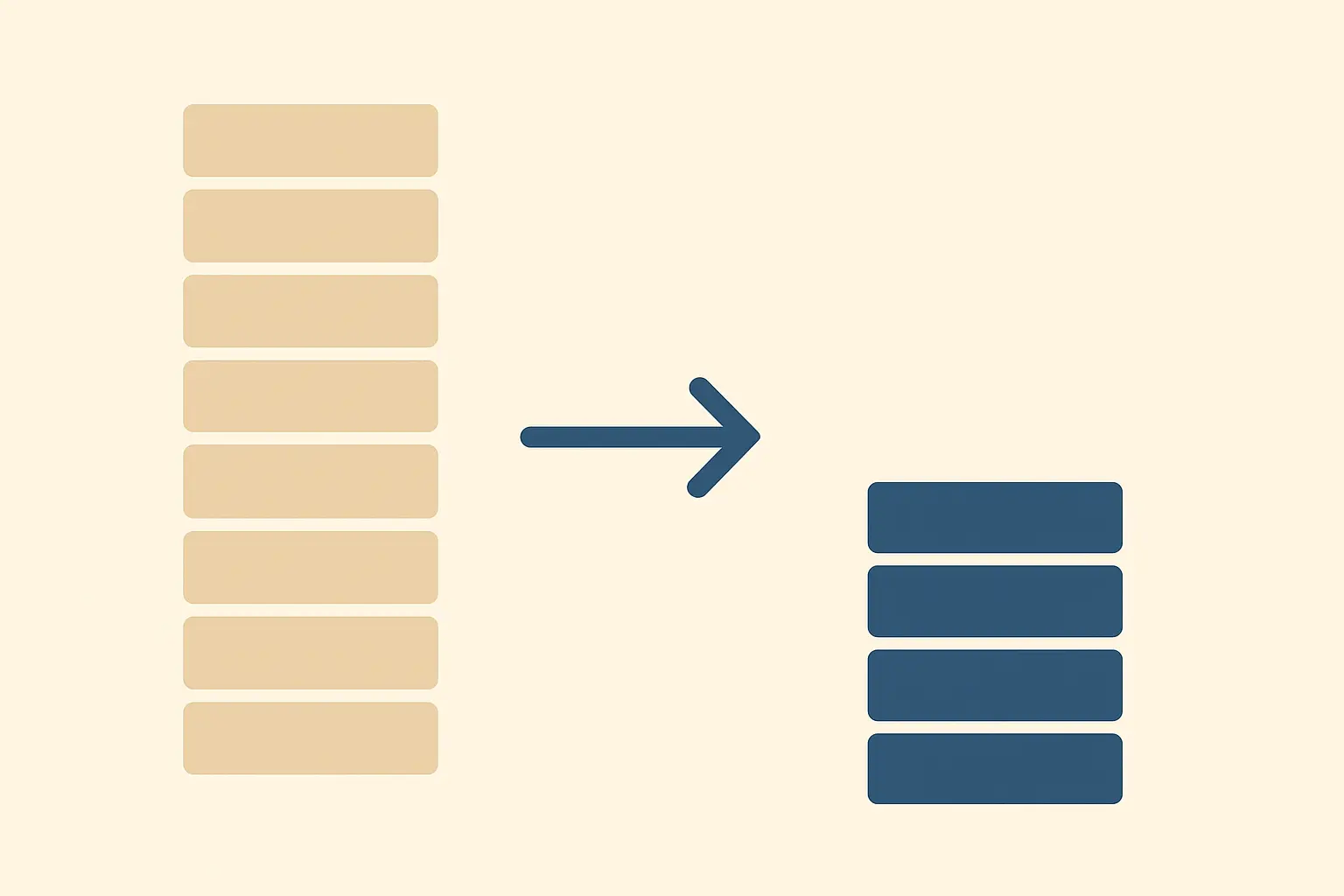
This is where the word count actually comes from, and it is subtraction rather than compression.
| In the thesis | In the article |
|---|---|
| Literature review of 6,000 to 10,000 words | Folded into the introduction, 600 to 900 words |
| Chapter-by-chapter roadmap paragraph | Deleted entirely |
| Definitions of standard terms in your field | Deleted; the readership already knows them |
| Justification of a well-known method | One sentence and a citation |
| Full instrument reproduced in an appendix | Named, cited, and supplied as supplementary material if allowed |
| Every analysis you ran | Only the analyses that bear on the reported claim |
| Reflexive statement, positionality, learning narrative | Retained only where the field expects it, and shortened |
The methods section is the exception: it usually gets denser, not shorter, because a journal expects reproducibility without the pedagogical framing. What has to survive the cut is set out in the guide to writing the methodology chapter — the elements that make the procedure repeatable stay; the elements that show your committee you understood the choices go.
Step 7: Rewrite the discussion for a reader who has no stake in you
A thesis discussion is partly an argument that you understand your own results. A journal discussion is an argument about the field. Keep the interpretation, keep the limitations with their direction of bias, and cut the reflective material about what you learned. The structural moves themselves — convergence, divergence, extension — carry over unchanged, and are worked through in the guide to writing the discussion chapter.
One addition: journals expect a shorter, harder future-directions paragraph than committees do. Two sentences, naming a design.
Step 8: Deal with copyright — yours, and other people’s
Two separate problems, and candidates usually notice only the second.
Other people’s material. A figure you reproduced under fair dealing in a thesis is not automatically clear for a commercial journal, because the purpose and the audience have changed. Re-check every third-party figure, table and instrument before submission; the analysis is in whether you need permission to use a published figure.
Your own material. If you have already published part of this work and assigned copyright to that publisher, you may need permission to reuse your own figures. Check the agreement you signed. Many journals now let authors retain reuse rights, but that is a term of the contract rather than a general rule.
Step 9: Do not create a redundant publication
The Tri-Agency Framework treats this as a breach of the responsible conduct of research, and the definition is broader than most candidates assume:
Redundant publication or self-plagiarism: The re-publication of one’s own previously published work or part thereof, including data, in any language, without adequate acknowledgment of the source, or justification.
Two phrases carry the weight. In any language means that publishing a French version of an English article, or the reverse, is squarely within the definition — a real risk in a bilingual research environment, and one that surprises people who assumed a translation was a new work. Without adequate acknowledgment of the source, or justification means the breach is not the reuse itself but the silence about it.
So the protective step is simple and it is a sentence: state in your cover letter, and usually in a footnote on the first page, that the work derives from your thesis, give the institution and the year, and give the repository link if it is public. Editors expect this. It converts an integrity problem into a routine disclosure.
The submission package, in one list
- Manuscript formatted to the journal’s structure and word limit.
- Title page with the agreed author list and order, affiliations, and a corresponding author with a durable email address.
- A cover letter naming the fit with the journal in two sentences, and disclosing the thesis origin in one.
- The thesis-derivation footnote in the manuscript itself.
- Any required declarations: ethics approval number, funding, conflicts, data availability, contributor statement.
- Permissions correspondence for third-party material, saved as files rather than links.
Set a calendar reminder for eight weeks. A polite one-line status query after that is entirely normal and costs you nothing.
Doing the rewrite without starting from a blank file
The hard part of this process is not judgement — you already made the judgements in the thesis. It is the mechanical rebuild: a new introduction, a compressed literature section, a reference list converted to a different style, and a document held consistent while three sections move at once. Tesify does that scaffolding, so the time you have goes to the four paragraphs of the introduction that actually decide whether an editor sends it out for review.
Rebuild your chapter as an article with Tesify
Frequently asked questions
Does publishing my thesis in a repository count as prior publication?
For most journals, no. Nearly all treat a deposited thesis as a form of preprint rather than a prior publication and say so in their submission policy. A minority disagree, so read the policy page for your specific target and save a dated copy before you submit.
How many articles should come out of a master’s thesis?
Usually one, and sometimes none. Two or more is normal for a doctoral dissertation with separate analyses. The test is how many claims survive when you delete everything that is new only to you.
Should my supervisor be a co-author?
Under the Tri-Agency Framework, authorship goes to all those and only those who made a substantial contribution and accept responsibility for the contents, and the contribution may be conceptual or material. A supervisor who shaped the design and revised the argument qualifies. One who signed forms does not.
Who should be first author on a paper from my thesis?
In most disciplines, the student who did the work. Propose it in writing and ask your supervisor to confirm in writing. Corresponding author is a separate role, often taken by the supervisor because an institutional address outlives a student account.
What is redundant publication, and could my thesis cause it?
The Tri-Agency Framework defines it as the re-publication of one’s own previously published work or part thereof, including data, in any language, without adequate acknowledgment of the source, or justification. Disclosing the thesis origin in your cover letter and in a first-page footnote removes the problem.
Can I publish a translated version of my own article?
Not silently. The definition of redundant publication explicitly covers re-publication in any language, so a translated version needs both the acknowledgment and a justification, and normally the agreement of both journals.
How much should I cut from the literature review?
Most of it. A thesis literature review of six to ten thousand words usually becomes six to nine hundred words folded into the introduction, keeping only the sources the argument actually stands on.
Do I need new permission for figures I already used in my thesis?
Often yes. A reproduction that was defensible in a thesis is not automatically clear for a journal, because the purpose and the audience have changed. Re-check every third-party figure, table and instrument before submission.
What if my supervisor never responds about the paper?
This is why the authorship email should include a time limit agreed at the start, such as proceeding after twelve months without a submission. Agreed in advance it is uncontroversial; raised afterwards it is a dispute.
How long should I wait before chasing an editor?
Eight weeks from submission is a reasonable point for a single polite status query. Desk rejection usually arrives much sooner, and silence past three months is worth a second enquiry.
Can a major research paper become a journal article?
Yes. An MRP is shorter and engages a narrower literature, so the compression work is lighter, but the same nine steps apply and the authorship conversation matters just as much.
Should I list my thesis in the reference list of the article?
Yes, if any material is drawn from it. Cite it as a thesis with the institution and year, and pair the citation with the disclosure footnote. That is exactly what adequate acknowledgment of the source means.