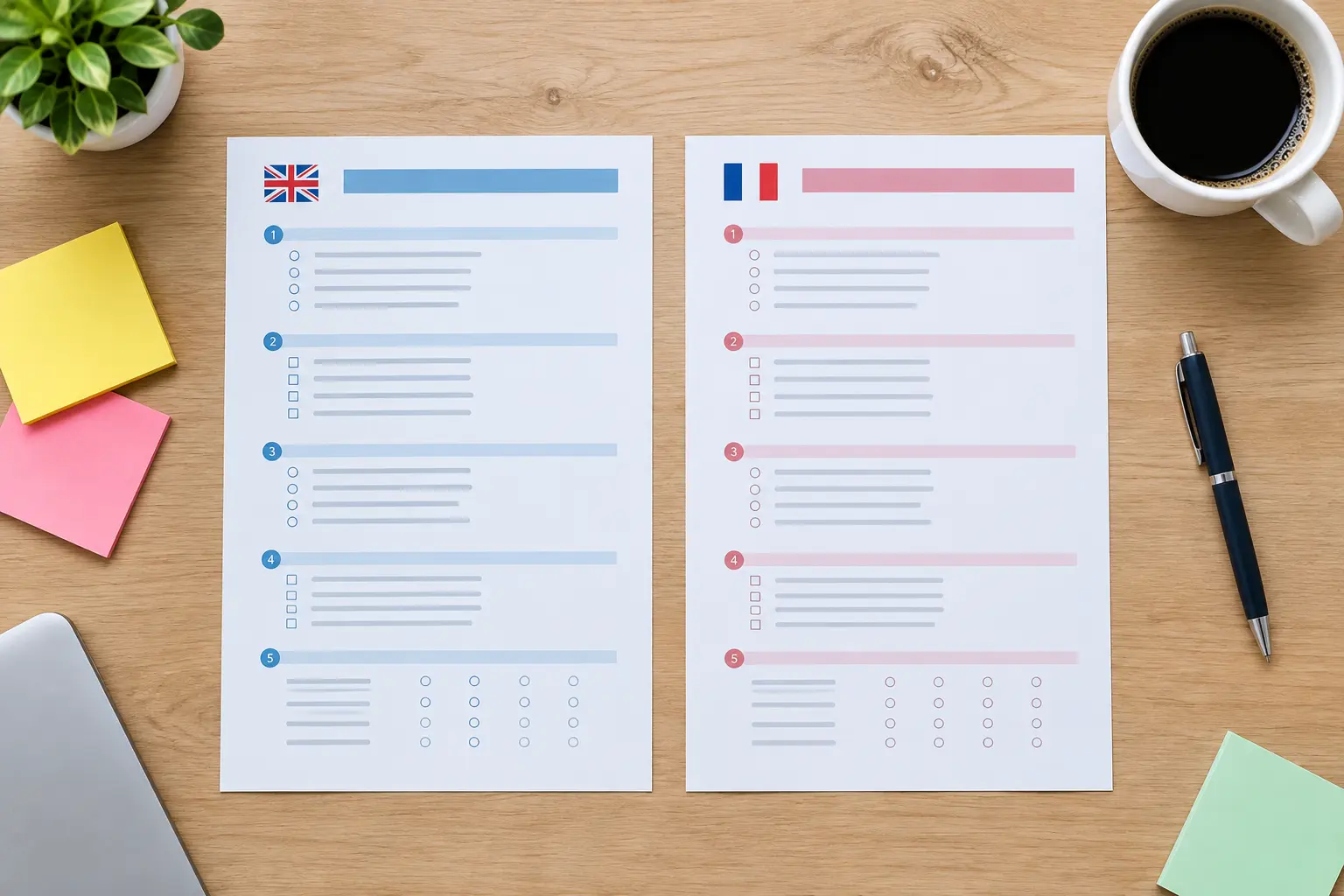
To translate and validate a questionnaire for a Canadian thesis, first check whether a validated version already exists in your target language. If not, follow a staged adaptation: two independent forward translations, a synthesis, back translation, an expert committee review, a pilot test of the pre-final version, then reliability and validity testing in your own sample. Document every decision.
Canada has two official languages, a large number of newcomers who answer surveys in a third language, and graduate programs that routinely borrow instruments built in another country. That is why “can I use this questionnaire in French?” and “can I just translate it myself?” are two of the most common methods questions a Canadian thesis student asks. This guide answers them in the order a committee will: do you need a new version at all, what does a defensible adaptation involve, how do you show the translated version still measures the same thing, and what should the methods chapter report?
Do I need to translate the questionnaire at all?
Often not. Before you plan any translation, work through three checks in order:
- Look for an existing validated version in your target language. Search the instrument’s name together with the language and “validation” in the library databases, and look at the developer’s own page. If a validated French (or other) version exists, cite it, use it as published, and report its reliability in your sample.
- Ask for permission. Many instruments are copyrighted. Contact the developer or the publisher before you translate or reproduce items, and keep the reply, because your committee may ask for it.
- Decide whether adaptation is needed or only translation. A change of language and country usually requires both; a change of country with the same language may require only cultural adaptation of wording and examples.
Only when all three checks say “no version, permission possible, adaptation needed” do you start a translation. A student who skips the first check can spend a term producing a worse version of something that already exists.
What does a defensible translation and adaptation involve?
The reference most health and social science students cite is Beaton, Bombardier, Guillemin and Ferraz (2000), “Guidelines for the Process of Cross-Cultural Adaptation of Self-Report Measures”, published in Spine (volume 25, issue 24, pages 3186-3191). Its approach has six elements: initial translation, synthesis of the translations, back translation, an expert committee, testing of the pre-final version, and appraisal of the adaptation process. Recent adaptation studies describe the typical set-up the same way: forward translation by two independent translators, back translation by two native speakers of the original language, an expert committee review, and then a test of the pre-final version.
Stage 1: two independent forward translations
Two translators whose first language is the target language translate the instrument separately. Ideally one is informed about the concept being measured and one is not, so that you see both a content-aware and a naive reading. Each writes a short report on the difficult items.
Stage 2: synthesis
A third person compares the two translations with each other and with the original and resolves discrepancies in wording, sentence structure and meaning, producing one preliminary version.
Stage 3: back translation
Two translators whose first language is the original language translate the preliminary version back, without seeing the original. The point is to detect items where the meaning has shifted.
Stage 4: expert committee
A committee compares all versions and decides on the pre-final text. Typical members are a methodologist, someone from your field, a language professional and the translators. The committee looks at four kinds of equivalence: semantic (do the words mean the same thing), idiomatic (colloquialisms and idioms), experiential (does the situation in the item occur in the target culture) and conceptual (does the underlying concept exist in both cultures).
Stage 5: pre-test of the pre-final version
You give the pre-final version to a small sample from your target population and ask what each item and instruction meant to them. This is where “cognitive interviews” are used. You are checking clarity, not collecting data for your results.
Stage 6: documentation
You keep a written record of every decision and, where possible, send it to the instrument’s developer.

Is back translation mandatory?
No, and this is worth knowing before you promise your committee a six-stage process you cannot staff. Epstein, Santo and Guillemin (2015) reviewed the literature in the Journal of Clinical Epidemiology and identified 31 guidelines. They found no consensus on cross-cultural adaptation methods, noted that most methods include committees, focus groups and back translation, and concluded that evidence for the best methods is lacking, with clues that back translation may not be mandatory.
For a master’s thesis, that gives you room to propose a proportionate design: for example, two forward translations, a committee review and a cognitive pre-test, with back translation added if you can recruit two qualified translators. State which stages you completed and why, and cite both Beaton et al. (2000) and Epstein et al. (2015) so your reader can see that the choice is deliberate and not an omission.
How do I show the translated version still measures the same construct?
Translation produces a text; validation shows the text works. Three kinds of evidence are normal in a graduate thesis, in increasing order of cost:
- Content validity from experts. Panel members rate each item for relevance to the construct. Studies commonly summarise ratings as an item-level content validity index (I-CVI) and a scale-level index (S-CVI). Report your panel size, the rating scale and the rule you used to keep or drop an item, and cite the source of that rule.
- Face validity and clarity from the pre-test. Report what respondents misunderstood and what you changed.
- Reliability and structure in your sample. Compute internal consistency (Cronbach’s alpha) in your own data, and compare it with the original. If it is low, read what counts as an acceptable Cronbach’s alpha before you decide what to do.
A factor analysis or a confirmatory test is appropriate only if your sample is large enough, and the required size depends on the number of items. If your sample cannot support it, say so as a limitation, rather than presenting an under-powered analysis as proof of validity. For sample-size reasoning in general, see population and sampling worked examples for a Canadian thesis.
Where do I find a checklist for judging the quality of the adaptation?
COSMIN, which stands for COnsensus-based Standards for the selection of health Measurement INstruments, is an international initiative that publishes a taxonomy of measurement properties and methodological quality checklists for studies of measurement instruments. You do not need to run a full COSMIN review, but reading its definitions will give you the correct terms for your methods chapter, and examiners in health fields expect to see them.

How do I handle a bilingual sample or a French and English version in one study?
If you collect data in both languages, treat language as a variable you must be able to defend. Report how many respondents completed each version, check that the reliability coefficient is similar in each group, and avoid pooling the two groups into one analysis without justification. The wording of the consent form and information letter must also be available in the language of the respondent, and your ethics board will expect to see both versions with your application. For the structure of the instruments appendix itself, see survey and interview instrument templates for a Canadian thesis.
What should the methods chapter report?
A reader should be able to repeat your process from the page. A complete paragraph names the instrument and its developer, the permission obtained, the languages, the number and qualifications of translators, the committee composition, the pre-test sample and what changed, and the reliability and validity evidence you collected. The following skeleton is illustrative and uses invented details; replace each element with what you actually did.
| Element | Illustrative wording |
|---|---|
| Source and permission | The scale was developed in English by its authors; permission to translate was obtained by email from the publisher. |
| Forward translation | Two independent translators whose first language is French produced separate translations. |
| Synthesis and back translation | The researcher and a third translator reconciled both versions; two English-first translators produced back translations. |
| Committee | A committee including a methodologist, a subject expert, a language professional and the translators approved the pre-final version. |
| Pre-test | The pre-final version was tested with a small group from the target population using cognitive interviews; items were reworded where respondents reported ambiguity. |
| Reliability | Cronbach’s alpha was computed in the thesis sample and compared with the original publication. |
What are the most common mistakes?
- Translating alone with an online translation tool and calling it validated. Machine translation can help a draft, but it does not replace independent translators and a review of meaning.
- Back translation that sees the original. The back translators must not have seen it; otherwise they reproduce it from memory.
- Treating a translation as a validated version. Without any evidence of reliability or validity in your sample, a committee will ask what shows the items still work.
- Changing items to suit your project. Rewording an item to fit your population is an adaptation, and it must go through the same committee and pre-test steps.
- Skipping permission. Check the developer’s terms before you publish the translated items in an appendix.
If your instrument measures a construct like resilience, see how one student would define and select a scale in our guide to resilience as a thesis variable, which explains how to check whether a validated French version exists.
Where Tesify fits
Once your instrument is ready, you still have to write the chapters around it. Tesify helps you structure and organise your thesis. 9,000+ students have written 15,000+ chapters with Tesify, and the text stays 100% written by you.
Frequently asked questions
Can I translate a questionnaire myself for my thesis?
You can produce a draft, but a defensible adaptation involves independent translators, a review of meaning and a pre-test. A single self-made translation with no evidence of reliability or validity is hard to defend.
What are the stages of cross-cultural adaptation?
Beaton and colleagues describe initial translation, synthesis, back translation, an expert committee, testing of the pre-final version and appraisal of the process.
Do I need back translation?
It is common but not universally required. A review of 31 guidelines found no consensus and noted clues that back translation may not be mandatory, so justify your choice and cite the review.
How many translators do I need?
Studies that follow the Beaton guidelines typically use two forward translators and two back translators, plus a committee. Smaller projects document what they were able to staff and why.
How do I check that my translated questionnaire is valid?
Collect expert ratings of item relevance, pre-test the pre-final version with the target population and compute reliability in your own sample. Add structural analysis only if the sample can support it.
What is a content validity index?
It summarises expert ratings of item relevance, usually at item level (I-CVI) and scale level (S-CVI). Report the panel size, the rating scale and your retention rule.
Do I need permission to translate a published scale?
Often yes. Check the developer’s or publisher’s terms and keep written permission, especially if you plan to print items in an appendix.
Does my ethics board need to see both language versions?
Typically yes. If participants respond in two languages, submit the consent form, information letter and instrument in both languages with your application.
What is COSMIN and do I have to use it?
COSMIN is an initiative that publishes a taxonomy of measurement properties and quality checklists. You do not have to run a full review, but its definitions help you use the correct terms.
What should I do if my reliability is lower than the original?
Report it, check item wording and sample characteristics, and discuss it as a limitation. Do not delete items solely to raise the coefficient.