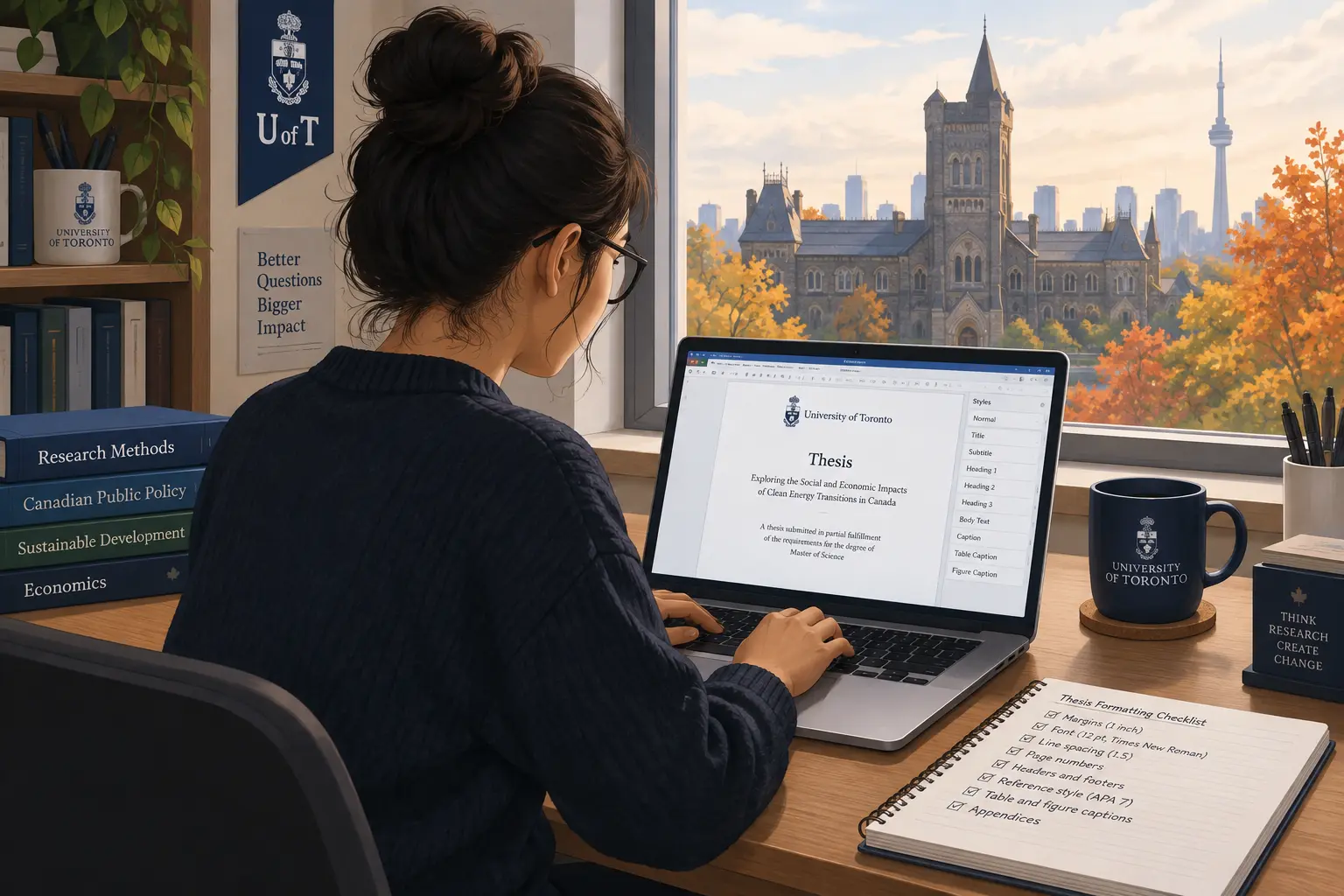
The University of Toronto’s School of Graduate Studies (SGS) requires a minimum 10-point font, at least one-and-a-half line spacing (double-spaced for the abstract only), specific margins, a fixed file-naming convention, and submission as a single PDF through the digital thesis system. Doctoral abstracts cannot exceed 350 words; master’s abstracts cannot exceed 150. Below is what SGS’s own current formatting page says, section by section, so you are not guessing at a rule your own faculty did not confirm.
What font, spacing and margins does SGS require?
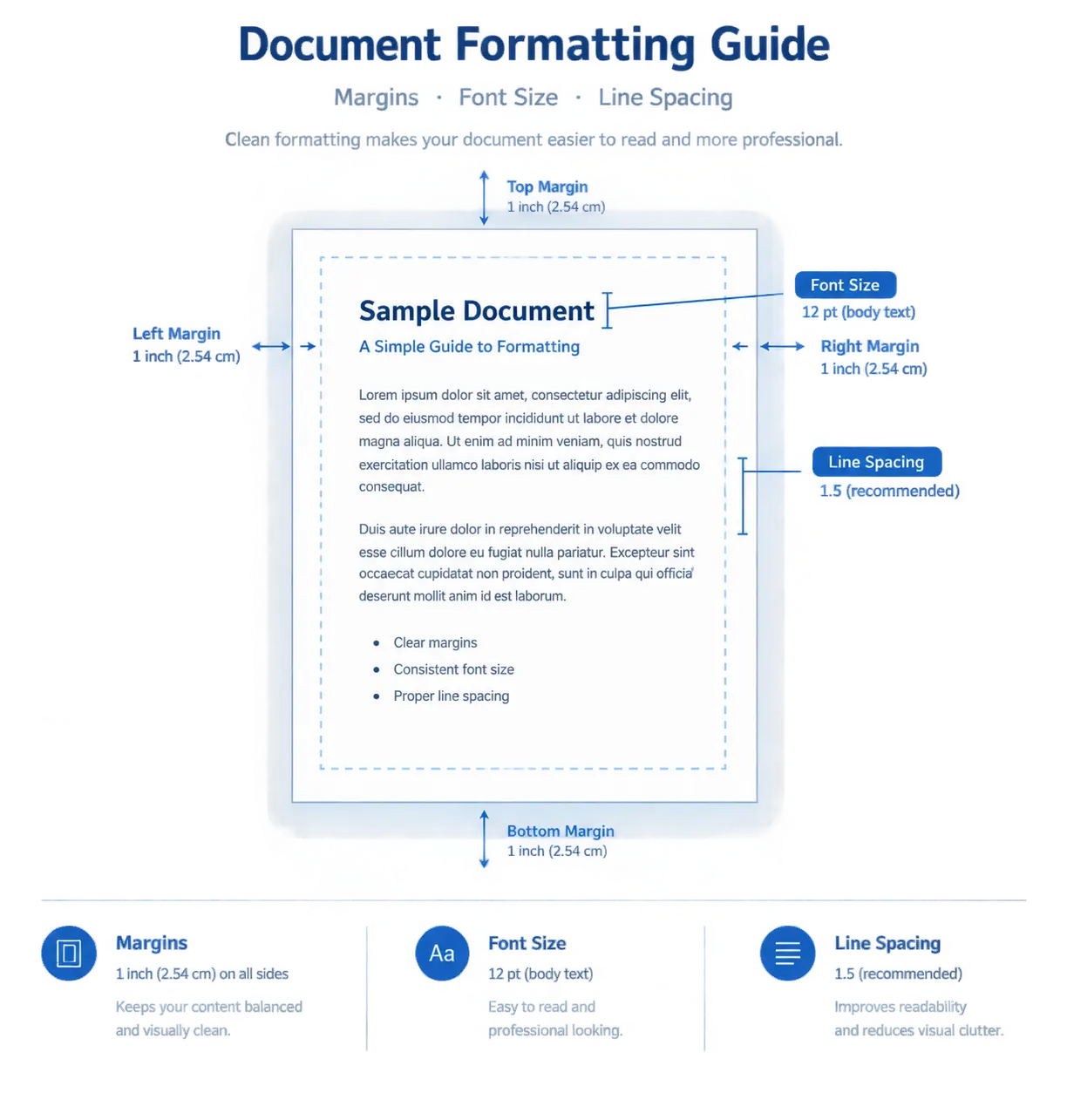
SGS’s formatting page states that body text “must be a minimum of 10 points,” with named exceptions for graphs, formulas, footnotes and appendices, where a smaller size may be used because it is not continuous reading text; the same page also asks you to avoid italics. Line spacing “must be at least one-and-a-half spaces, except for the thesis abstract, which should be double-spaced.” For a printed or bound copy, the left margin should be at least 1¼” (32 mm) and the remaining three margins at least ¾” (20 mm); SGS notes that margin sizes are not as critical in digital formats, which matters because almost every thesis at U of T is now submitted and read as a PDF rather than bound and shelved.
These are minimums, not house style. Individual graduate units sometimes ask for a specific font or a slightly larger body size for readability; SGS’s rule is the floor everyone must clear, not the ceiling any one department sets. A thesis that technically clears 10-point type but reads as cramped at that size, with 1.5 spacing rather than double, is a common reason a supervisor sends a chapter back for reformatting even when no SGS rule was actually broken — the floor and “what your committee finds comfortable to mark up” are not the same thing.
How long can the abstract be?
SGS caps the doctoral thesis abstract at 350 words and the master’s thesis abstract at 150 words, and requires the abstract itself to be double-spaced in the same minimum 10-point font as the rest of the document. The thesis title, degree and year of convocation, your full name, graduate department and university must appear at the top of the abstract’s first page, and that information is not included in the 350- or 150-word count. Both limits are strict enough that most students draft the abstract last, once the actual findings and contribution are settled, rather than trying to compress a moving target early. A 350-word doctoral abstract is roughly one printed page; a 150-word master’s abstract is closer to a long paragraph, which is a tighter constraint than many students expect walking in. Because the limit is enforced at the word level, not the page level, an abstract that looks short on the page but runs long in word count (dense compound sentences, few short words) can still fail the check — run an actual word count on the abstract text alone before you consider it final.
What is the required file name for the thesis PDF?
SGS specifies an exact naming convention for the single PDF file you submit: lastname_firstname_middleinitial(s)_graduationyearmonth_degreedesignator_thesis.pdf. The example SGS itself gives is Smith_Lorie_L_201711_PhD_thesis.pdf — note the year-month format (2017, November) rather than a full date, and the abbreviated degree designator rather than the full degree name. A worked comparison: Nguyen_Anh_T_202606_MA_thesis.pdf is correctly formed for a June 2026 MA graduate named Anh T. Nguyen, while Nguyen-Anh-MA-Thesis-Final-v3.pdf is not, even though a human reader can tell what it means — the automated intake at the submission system is checking the pattern, not the intent. Getting this wrong is one of the more common reasons a submission bounces back at the administrative check, before it ever reaches a reader, so copy the pattern exactly rather than approximating it.
Does the thesis have to be a single PDF?
Yes. SGS’s page is explicit that “the thesis must be in PDF format,” created through Adobe Acrobat or other PDF-creation software, as a single main text-based file containing the complete, defended, corrected document — title page through appendices. If your thesis includes supplementary files that cannot be embedded as PDF pages (raw datasets, video, code repositories), SGS allows them as supplementary files following the same naming convention, but they are not a substitute for the main thesis PDF; check with your graduate unit before assuming a supplementary file satisfies the main submission requirement.
Where do you actually submit the thesis?
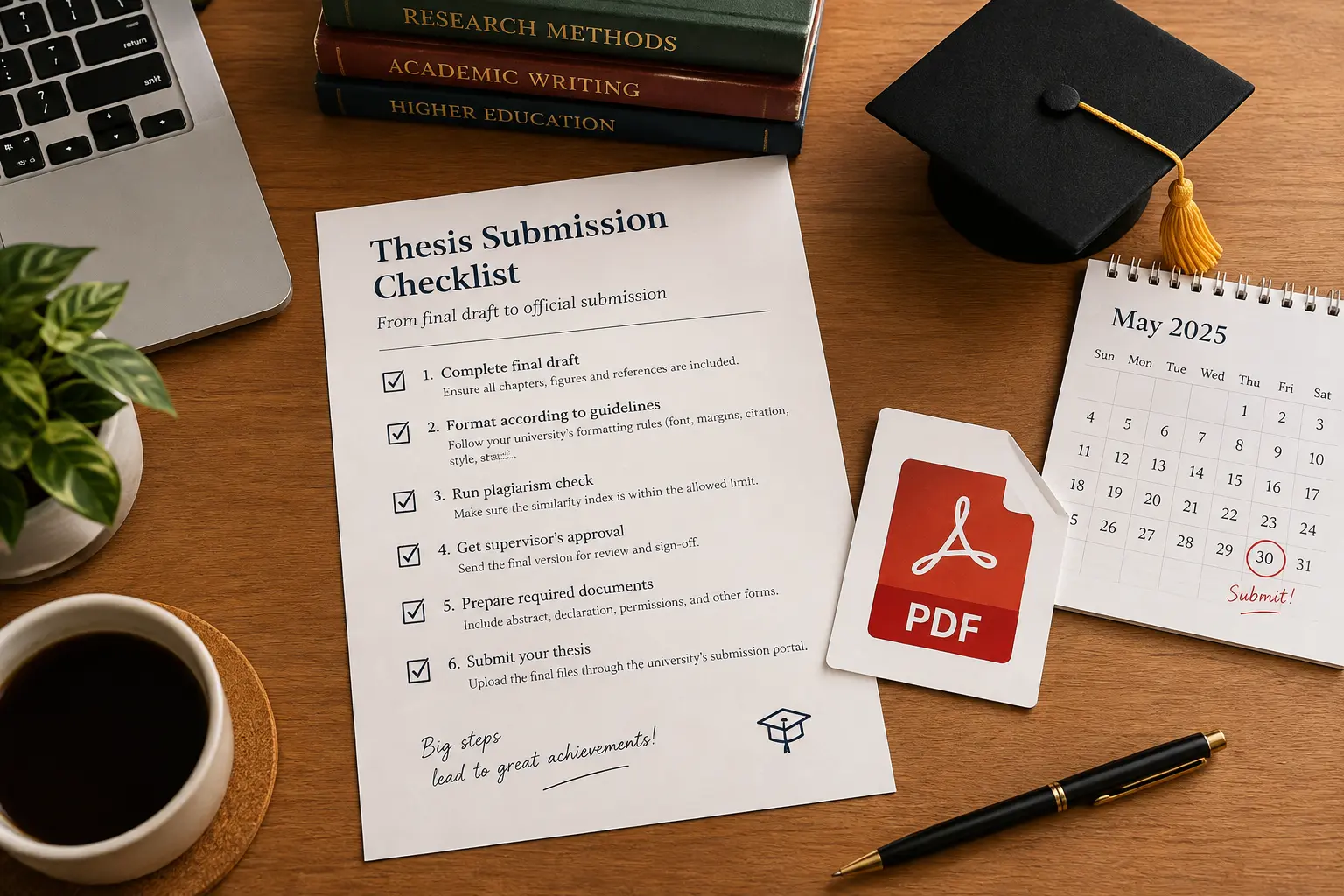
SGS’s formatting page links to the digital thesis repository at etdadmin.com/toronto, ProQuest’s ETD Administrator, for converting and submitting the final PDF. SGS states that your program requirements are not officially complete until your thesis has been accepted by SGS through ProQuest — the defended, correctly formatted thesis, incorporating every correction required after the final oral examination. Confirm the current submission deadline for your convocation period directly with your graduate unit’s academic coordinator, since that date moves each cycle and is not fixed on the formatting page itself.
Can a University of Toronto doctoral thesis be built from published articles?
SGS’s own doctoral thesis guidelines describe a manuscript-based (article-based) format as an accepted alternative to a traditional single-monograph thesis, evaluated by the examination committee in the form it is actually presented for the final oral exam. On the number of articles required, SGS’s guidance states that it “is usually three, although the number depends on the articles’ scope, scientific quality and significance, and publishing forum” — in other words, three is a starting expectation, not a fixed rule, and a committee can accept fewer, higher-impact articles or ask for more shorter ones depending on the work. Whether your own graduate unit actually permits the manuscript-based format at all is a departmental decision on top of this SGS-level allowance, so confirm it with your supervisor before you plan a doctoral thesis around three publishable papers rather than one continuous monograph.
Will your thesis be made public after you graduate?
SGS states plainly that publication of the thesis is a requirement of the degree, and that “it is U of T’s intention that there be no restriction on the distribution and publication of theses” — meaning theses are released after each convocation and made freely available online by default, not held back or restricted to campus access. A student who genuinely needs a temporary restriction (a pending patent, a publisher’s embargo on a chapter, sensitive data) has to request it formally with a Thesis Embargo Request form signed by the graduate unit chair and submitted to SGS; it is not the default state, and it is not something you can assume will be granted by simply asking late.
Do these rules apply the same way to every graduate unit at U of T?
The formatting minimums above — font, spacing, margins, abstract length, file naming, PDF submission — are set centrally by SGS and apply university-wide. What is not centralised is everything above the floor: citation style, chapter structure, the exact manuscript-based-thesis policy for your specific department, and the defence and examining-committee process for your programme. Those vary by graduate unit and sometimes by supervisor, so SGS’s own guidance repeatedly points students back to their supervisor and home department for discipline-specific formatting and for anything beyond the university-wide formatting floor.
What should you check before you start formatting?
- Confirm your exact font and size with your graduate unit — 10 points is the SGS floor, not necessarily what your department expects for comfortable reading.
- Draft the abstract last, and count words against the 350/150 limit before you consider it final — both are stricter than a typical journal abstract limit, and the limit is checked in words, not visual page length.
- Name the file exactly to the SGS pattern before uploading to the conversion and submission system, including the year-month format and the abbreviated degree designator.
- Ask your graduate unit, not SGS’s general page, about a manuscript-based thesis, defence format, and examining-committee composition — these live at the department level, even though the three-article starting expectation itself is set by SGS.
- Decide early if you need a publication restriction, since the default is full public release after convocation and a restriction has to be requested, not assumed.
Turning an approved outline into a formatted draft
None of the SGS formatting rules above tell you what to write — only how the finished document has to look and where it has to land. Once your supervisor has approved your chapter outline, the actual drafting work (turning a methodology outline into full prose, keeping the abstract inside 350 or 150 words on the first real attempt rather than the fifth) is where most of a term’s writing time goes. Tesify can help you turn an approved outline into full chapter prose you still review, edit and take ownership of section by section — it drafts with you, it does not submit anything in your name. Check Tesify’s own pricing page for current plans rather than assuming a figure here.
For the university-wide formatting picture across several institutions, see thesis format in Canada: title page, margins and layout at UofT, UBC and others, and for a second Canadian graduate school’s own submission system side by side with this one, University of Waterloo’s thesis requirements is a useful comparison. If you are still at the proposal stage, a worked thesis introduction chapter example is a useful next stop, and how to cite in APA 7th edition covers the citation-style question SGS itself leaves to your department.
Frequently asked questions
What font size does the University of Toronto require for a thesis?
SGS requires a minimum of 10 points for the main body text, with smaller sizes allowed only in graphs, formulas, footnotes and appendices. Individual graduate units may ask for a larger size for readability, so confirm with your own department before finalising your template.
How long can a University of Toronto thesis abstract be?
A doctoral thesis abstract cannot exceed 350 words; a master’s thesis abstract cannot exceed 150 words. Both must be double-spaced, unlike the rest of the document, which uses at least one-and-a-half line spacing.
What file format does SGS require for the final thesis?
A single PDF file, created with Adobe Acrobat or other PDF-creation software, containing the complete, defended and corrected thesis from title page through appendices.
What is the University of Toronto’s thesis file naming convention?
SGS specifies lastname_firstname_middleinitial(s)_graduationyearmonth_degreedesignator_thesis.pdf, with the example Smith_Lorie_L_201711_PhD_thesis.pdf given on its own formatting page. Getting the pattern exactly right avoids an administrative bounce-back before your submission is even reviewed.
Where do University of Toronto graduate students submit their thesis?
Through ProQuest’s ETD Administrator at etdadmin.com/toronto, linked from SGS’s formatting page. Program requirements are not officially complete until the corrected, defended thesis has been accepted by SGS through ProQuest.
Will my University of Toronto thesis be publicly available after I graduate?
Yes, by default. SGS states that publication is a requirement of the degree and that there is no intended restriction on distribution, so theses are released after each convocation and made freely available online. A temporary restriction has to be formally requested through your graduate unit; it is not automatic.
What are the margin requirements for a University of Toronto thesis?
For a printed or bound copy, the left margin should be at least 1¼ inches (32 mm) and the other three margins at least ¾ inch (20 mm). SGS notes that margin sizes are not as critical in digital formats.
Does SGS set the citation style for University of Toronto theses?
No. SGS’s formatting rules cover font, spacing, margins, abstract length, file naming and PDF submission university-wide, but citation style, chapter structure and whether a manuscript-based thesis is accepted are set at the graduate-unit or departmental level, not by SGS centrally.
Can a University of Toronto doctoral thesis be assembled from published articles instead of written as one monograph?
SGS’s own doctoral thesis guidelines describe a manuscript-based format as an accepted alternative, usually built around three articles, though the exact number depends on each article’s scope, quality and significance. Whether your own department actually permits this format is a separate, departmental-level decision, so confirm with your supervisor before planning around it.