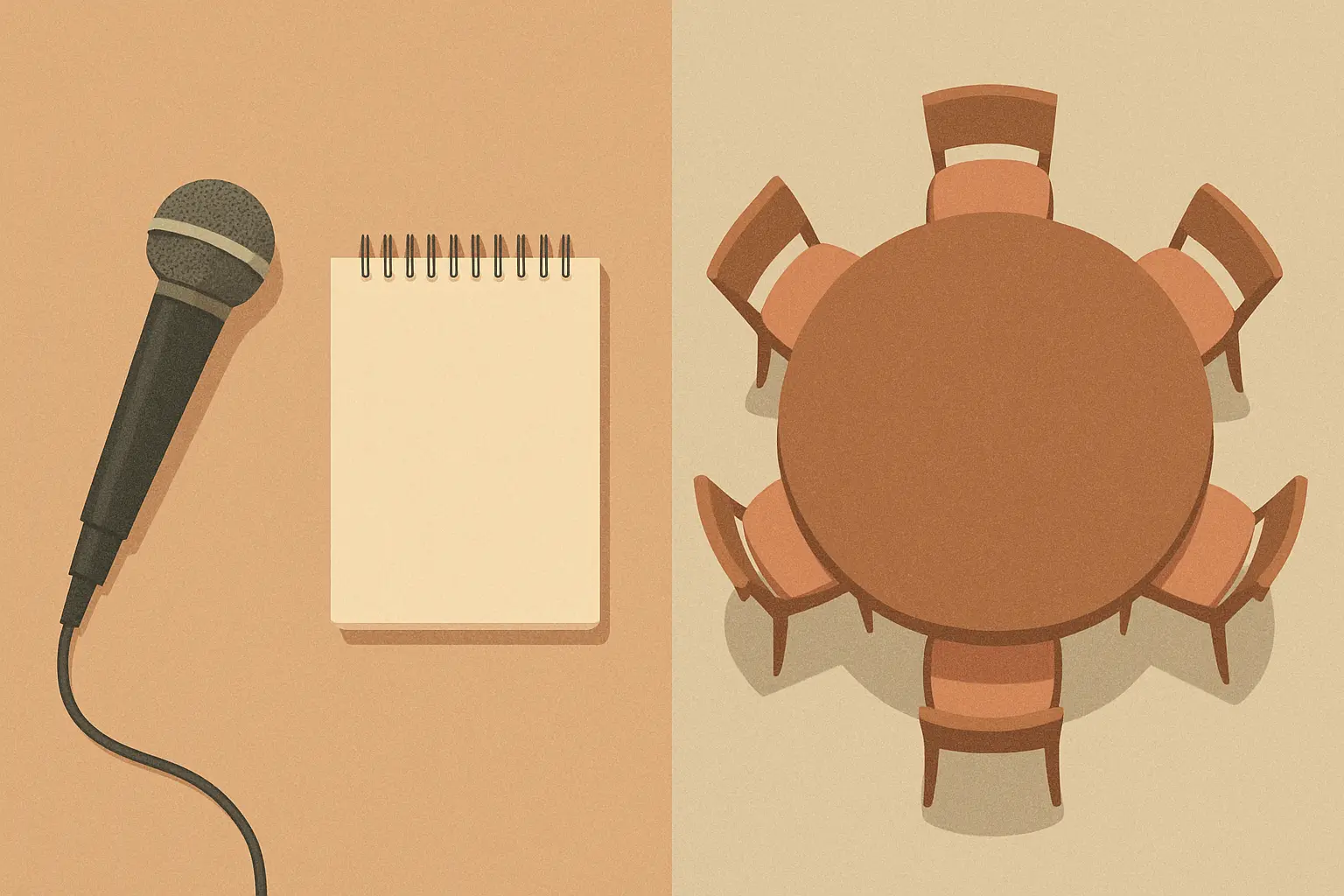
| Criterion | One-on-one interviews | Focus groups |
|---|---|---|
| Best for | Individual decision journeys, sensitive purchase motives (debt, health, price shame), brand-switching stories | How consumers react and build opinions in front of each other — group norms, social proof, word-of-mouth dynamics |
| Common planning range (justify your own) | Roughly 8–15 one-on-one sessions, continued until thematic saturation | Several groups (often 4–6) of about 6–8 participants each |
| Typical session length | 45–60 minutes | 60–90 minutes, but shared across 6–8 people at once |
| Where it breaks | Cannot observe how opinions form or shift under peer influence | A dominant participant can suppress others’ honest answers; not suited to genuinely private topics |
| REB burden | Lower — one voice per recording, easier anonymization | Higher — group confidentiality cannot be fully guaranteed by the researcher |
The recommendation: if your research question is about an individual consumer’s private reasoning — why they switched brands, how they justified a purchase, what they actually felt about a price — run interviews. If your research question is about how consumers influence each other, react to a stimulus together, or reveal norms they would not state alone (what “feels cheap,” what a brand “should” cost), run focus groups. Many Canadian marketing theses need only one method; running both without a clear reason for each adds REB burden without adding analytic value. If you have not yet decided your design needs qualitative data at all, see how many participants you need for a thesis for the quantitative-side comparison first.
When does an interview genuinely beat a focus group for a marketing thesis?
Interviews are the right call whenever the phenomenon you are studying is something a participant would answer differently in front of peers than alone — most consumer-behaviour research on price sensitivity, financial anxiety, health-product purchases, or brand disloyalty falls into this category, because admitting “I bought the store brand because I couldn’t afford the name brand” is a different sentence in a room of strangers than on a one-on-one call. Interviews also suit any thesis tracing an individual decision journey over time — how a consumer moved from awareness to consideration to purchase for a specific product category — because a group setting compresses and homogenizes that kind of narrative.
When does a focus group genuinely beat an interview?
Focus groups earn their extra REB and logistics burden when the group dynamic is the data — testing how consumers react to a new ad concept in real time, watching group consensus form around what a fair price “feels like,” or observing how one participant’s story of a bad brand experience shifts others’ stated intentions mid-session. A focus group is also the more efficient choice when your research question needs breadth across many voices on a topic with low sensitivity (packaging preferences, ad recall, general category perceptions) rather than depth on one person’s private reasoning.
How do you decide sample size for either method?
For interviews, plan for thematic saturation rather than a fixed number: a planning range of roughly 8 to 15 one-on-one sessions is common in qualitative consumer research, but the stopping rule, not the number, is what you defend — the honest way to state this in a proposal is a target range plus an explicit rule such as “data collection will continue until two consecutive interviews add no new themes to the coding framework.” For focus groups, the unit that matters is the number of groups, not the number of participants within them, because each group is treated as one unit of analysis for identifying dynamic patterns; four to six groups of about 6–8 participants is a common planning range, with more groups needed if you are comparing across distinct consumer segments (e.g., three groups of existing customers and three of lapsed customers) rather than treating your sample as one homogeneous population. Both numbers are starting estimates to justify in your proposal, not fixed rules — state the reasoning, not just the figure.
What does a marketing interview guide look like?
“Opening (rapport, low-stakes): ‘Tell me about the last time you bought [product category]. Walk me through it from when you first thought about buying to when you actually paid.’ Core — awareness and consideration: ‘What brands did you consider, and why those?’ ‘What made you rule any of them out?’ Core — the switch (if applicable): ‘You mentioned you used to buy [prior brand]. What changed?’ ‘Was there a specific moment, or did it happen gradually?’ Core — price and value: ‘How did you decide the price was worth it?’ Probes (planned, not scripted verbatim): ‘Can you say more about that?’ ‘What did that feel like at the time?’ Closing: ‘Is there anything about this decision I haven’t asked about that feels important?’ Debrief: thank participant, confirm consent for the recording, remind them they may withdraw data up to [your stated deadline].”
Why it works: the guide moves from low-stakes to high-stakes questions in order, so trust is built before the participant is asked to justify a financial decision, and the planned probes are phrased generically enough to follow whatever the participant actually says rather than forcing them back onto a script.
What does a marketing focus-group moderator guide look like?
“Ground rules (2 minutes): ‘There are no wrong answers here — I’m interested in your honest reactions, even if they disagree with each other.’ Warm-up (5 minutes): ‘Go around the table — what’s a brand in [category] you feel genuinely loyal to, and why?’ Stimulus reaction (15 minutes): show the concept/packaging/ad; ‘What’s your first reaction?’ followed by ‘Does anyone see it differently?’ to deliberately surface disagreement rather than let the first answer anchor the room. Price perception (10 minutes): ‘If you saw this on a shelf with no price tag, what would you guess it costs?’ followed by revealing the actual price and asking for the reaction. Group dynamic check (ongoing): if one participant has spoken more than the others for two consecutive questions, redirect: ‘I’d like to hear from someone we haven’t heard from yet.’ Closing (5 minutes): ‘What’s one thing about this you’d tell a friend?’”
Why it works: the “does anyone see it differently” prompt is doing real methodological work — without it, focus groups tend to converge on the first confident answer, which produces an artificially unified transcript that under-represents genuine disagreement; the group-dynamic check keeps one voice from becoming the whole dataset.
What happens to the recordings after the session?
Both methods produce audio (or video) that needs transcription before thematic coding can begin, and the transcription route you choose is itself an REB-relevant decision — a cloud transcription service that stores audio outside Canada raises data-residency questions your ethics application must address. If you have not yet chosen a transcription route, the full comparison of REB-acceptable options is in transcribing research interviews for a Canadian thesis; the guidance there applies identically to focus-group audio, with the added note that a group recording typically needs speaker-labelling, which not every transcription service handles reliably — check a short test clip before committing to a full-session upload.
How does coding an interview transcript differ from coding a focus-group transcript?
Both methods usually end in thematic analysis, but what counts as the unit of analysis differs in a way that affects your coding framework from the first pass. In an interview transcript, each participant’s full response is a coherent, individually attributable account — a code applied to one participant’s answer can be compared cleanly against the same code applied to another participant’s answer, because nothing about how one person spoke shaped how the next one did. In a focus-group transcript, an utterance is never fully independent of what was said just before it: a participant who agrees with the previous speaker may be genuinely agreeing, or may simply be reluctant to voice a different view in the room — a distinction a transcript alone often cannot resolve. Two practical adjustments follow. First, focus-group coding typically adds a “conversational context” note alongside each coded excerpt (what was said immediately before it, and whether the excerpt agrees, disagrees, or shifts the group’s direction), which an interview transcript’s coding does not need. Second, a theme that appears in only one focus group out of four or six carries a different evidentiary weight than a theme repeated across most interviews in an interview-based sample, and a methodology chapter should say so explicitly rather than reporting both as equally supported findings — a theme raised by one vocal participant in one group is not the same strength of evidence as a theme independently volunteered across a majority of one-on-one interviews.
What five mistakes do marketing thesis committees flag in qualitative fieldwork?
| What committees flag | The fix |
|---|---|
| Running focus groups for a topic participants would not discuss honestly in front of peers | Re-check the topic’s sensitivity against the interview-vs-focus-group table before scheduling |
| A moderator guide with no plan for a dominant participant | Write the redirect line into the guide itself, not left to improvisation |
| Interview probes that are actually leading questions in disguise | Test each probe: does it suggest an answer, or only invite elaboration? |
| No stated saturation or stopping rule for the number of interviews or groups | State in the methodology chapter how many sessions were planned and why, and what would trigger adding more |
| Group confidentiality promised to participants as if it were guaranteed | State explicitly that the researcher cannot control what other participants disclose afterward |
Ready to turn your fieldwork into a written methodology chapter? Start free with Tesify and draft the method-justification paragraph your committee expects.
Frequently asked questions
Can a marketing thesis use both interviews and focus groups?
Yes, in a sequential mixed-methods design — focus groups first to surface the range of reactions, then interviews to probe individual reasoning behind the strongest reactions, or the reverse; state the sequencing rationale explicitly rather than running both without a stated reason.
Does a focus group need REB approval in Canada?
Yes, the same TCPS 2 process as an interview study applies, with an added consideration: the researcher cannot guarantee what other participants do with information shared in the room, which your consent form must state plainly. See the full TCPS 2 requirements guide.
How many focus groups are enough for a marketing thesis?
Four to six groups is a common planning range rather than a rule, and the right number depends on how homogeneous or diverse your target segments are; state your planned number and your stopping criterion in the proposal rather than an open-ended “as many as needed.”
Should I record focus groups on video or audio only?
Audio is sufficient for most thematic analysis and is easier to anonymize in transcription; use video only if body language or product handling is itself part of your research question, and say so explicitly in your ethics application.
What if one focus-group participant dominates the conversation despite my redirects?
Note it in your methodology chapter as a limitation of that specific session rather than silently smoothing it over in the transcript — a committee reading an honest limitations paragraph trusts the rest of your data more, not less.
Can I use an online focus group instead of an in-person one?
Yes, and it is increasingly common for reaching geographically dispersed Canadian samples; state the platform used, how consent and recording were handled, and any limitation specific to reading group dynamics over video rather than in person.
How is a marketing interview guide different from a psychology or education one?
The structure — rapport, core questions, probes, closing — is similar across disciplines; what differs is the content, which for marketing centres on decision journeys, brand perception, and price reasoning rather than clinical or pedagogical constructs.
Do I need a different consent form for a focus group than for an interview?
Yes — a focus-group consent form must additionally ask participants to respect each other’s confidentiality after the session, since the researcher can only control their own handling of the data, not what a fellow participant repeats afterward; many REBs will flag a consent form that does not distinguish the two.