
Most lists of nursing thesis topics are lists of interesting subjects. Interest is not the constraint. In a Canadian master’s programme the binding constraint is approval: how many separate permissions your topic needs, from how many bodies, and how long each takes. A topic requiring only your university’s research ethics board can be under way in weeks. The same idea, asked about patients instead of nurses, can take a year to clear.
So these forty topics are sorted by approval tier rather than by clinical area. Each carries a research question you can take to a supervisor. Choose from tier 1 if you are already behind; choose from tier 3 only if you have a supervisor with existing access and at least eighteen months.
A note on what this list is. The topics are shapes for a study, not findings. None asserts that a problem exists at any named institution; establishing that is your first chapter’s job, and the problem statement guide includes a worked nursing specimen.
The four approval tiers
| Tier | What it needs | Realistic lead time |
|---|---|---|
| 1 | No human participants: published literature, publicly available datasets, policy documents | Often an REB exemption or delegated review |
| 2 | Nurses, students or the public as participants, recruited outside a care setting | University REB alone |
| 3 | Participants recruited inside a health facility, or staff approached at work | University REB plus the facility’s or health authority’s research approval |
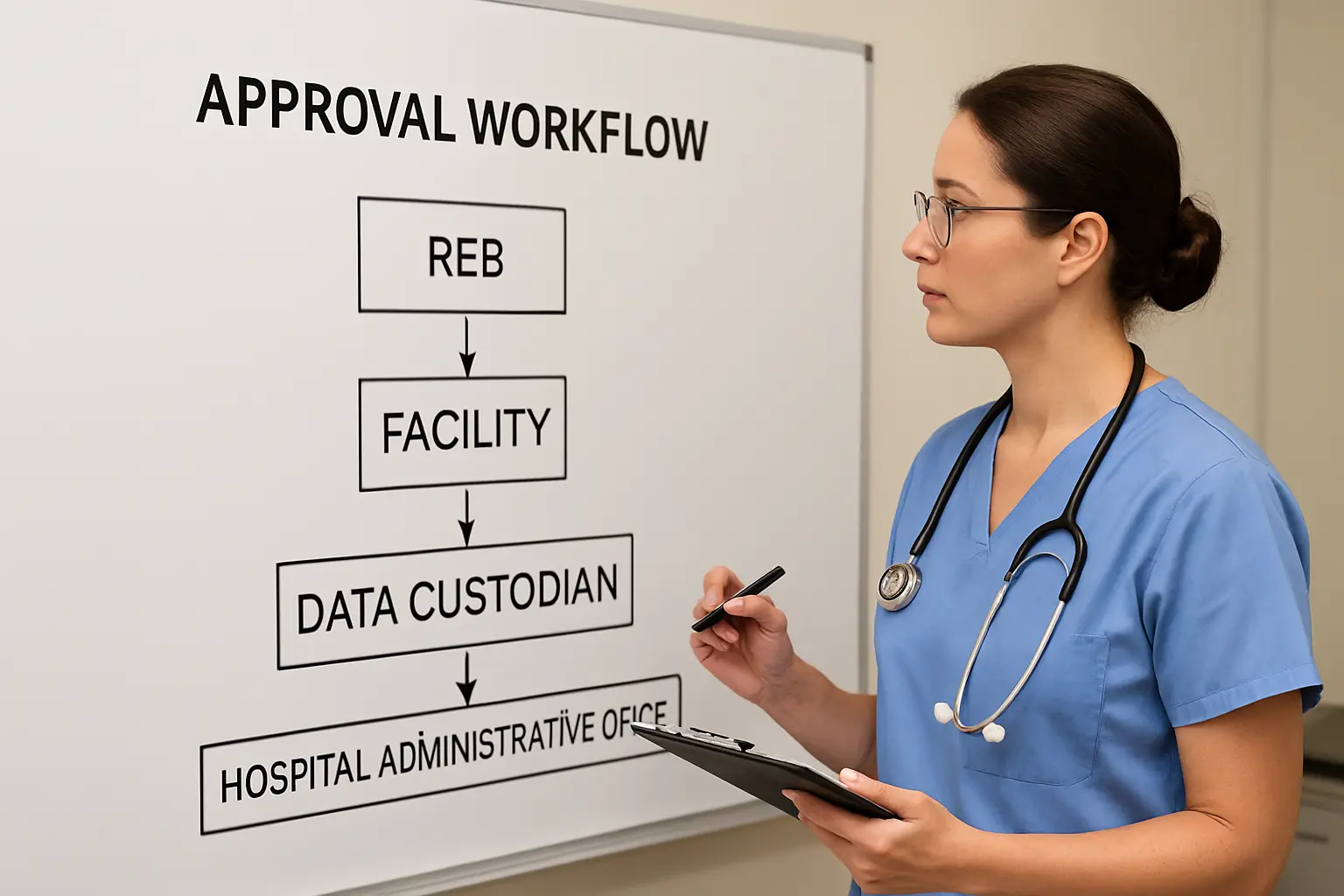
| 4 | Patient data, charts or linked administrative records | REB plus data custodian approval, and usually a privacy impact assessment |
The Tri-Council Policy Statement (TCPS 2, 2022) governs the ethics side at every tier. The tiers above it are institutional: a health authority’s own research office, a data custodian, a privacy officer. Adding one body to the chain rarely adds a little time; it adds a queue. The application itself is walked through in the REB approval guide.
Tier 1 — no human participants (10 topics)
- Discharge-planning interventions for multimorbid older adults. RQ: What intervention components are common to studies reporting reduced readmission, and which are reported inconsistently enough to prevent pooling?
- Nurse-led minor-ailment services across provincial scopes of practice. RQ: How do published provincial scope documents differ in the conditions nurses may assess independently?
- Reporting quality of nursing intervention trials. RQ: To what extent do recent Canadian nursing trials report the elements required by the relevant reporting guideline?
- Definitions of “missed care” in the measurement literature. RQ: How many distinct operational definitions are in use, and do studies using different ones reach different conclusions?
- Workplace violence policies in Canadian health authorities. RQ: What reporting obligations and supports do publicly posted policies place on front-line staff, and how do they differ?
- Simulation in undergraduate nursing curricula. RQ: What outcomes are used to evaluate simulation, and how many are learner-reported rather than performance-based?
- Cultural safety in published nursing education standards. RQ: How is cultural safety operationalised in publicly available curriculum documents, and what is assessed?
- Virtual care guidance for nursing practice. RQ: What do publicly available professional guidance documents say about assessment that cannot be performed remotely?
- Aggregate health administrative indicators. RQ: Using publicly released aggregate indicators, how does a chosen nursing-sensitive outcome vary across regions over five years?
- Nursing workforce data. RQ: What can publicly released workforce statistics establish about supply trends, and what do they structurally omit?
Topics 9 and 10 depend on what is actually released publicly versus held behind an access request, which is a distinction worth settling before you commit — the routes are mapped in the Statistics Canada microdata guide. Topic 1 or 3 done as a systematic review has its own protocol requirements, set out in the systematic review guide.

Tier 2 — participants outside a care setting (10 topics)
- Transition to practice among new graduates. RQ: How do nurses in their first eighteen months describe the gap between their education and their first assignment?
- Intention to leave among nurses recruited through professional associations. RQ: Which working conditions are most strongly associated with stated intention to leave the profession, as opposed to the employer?
- Rural practice decisions. RQ: What factors do nurses cite for choosing or leaving rural and remote practice?
- Nursing students’ clinical placement experience. RQ: How do students describe the conditions that made a placement useful rather than merely completed?
- Internationally educated nurses and the registration pathway. RQ: What do internationally educated nurses identify as the most consequential step in the registration process?
- Burnout and recovery in shift workers. RQ: What off-shift practices do nurses associate with recovery, and how do they vary by rotation pattern? See which burnout scale to use before designing this one.
- Continuing education uptake. RQ: What barriers do practising nurses report to completing continuing competence requirements?
- Nurse practitioners’ scope in primary care. RQ: How do nurse practitioners describe the boundary between their scope and physician scope in their own setting?
- Public expectations of nursing roles. RQ: What do members of the public expect a nurse to be able to do without a physician’s involvement?
- Preceptorship. RQ: What do preceptors identify as the support that would most change their willingness to precept again?
These are the workhorse topics of a Canadian master’s thesis: real questions, a single approval body, and a population reachable through an association, an alumni list or a professional network. The sampling logic for exactly this situation is set out in the population and sampling guide.
Tier 3 — recruitment inside a facility (10 topics)
- Handover communication on a medical unit. RQ: What information is consistently transferred at shift handover, and what is consistently lost?
- Nurses’ use of a clinical decision-support prompt. RQ: Under what circumstances do nurses override a decision-support alert, and how do they account for it?
- Falls prevention as enacted. RQ: How does the enacted falls-prevention routine on a unit differ from the written protocol, and why?
- Interprofessional rounds. RQ: What contribution do nurses make during interprofessional rounds, and what shapes whether they speak?
- Pain assessment in patients who cannot self-report. RQ: Which assessment approach do nurses use, and how do they resolve disagreement with a colleague?
- Nurse staffing and perceived care left undone. RQ: How does the amount of care nurses report leaving undone vary across shifts on the same unit?
- Response to deteriorating patients. RQ: What do nurses describe as the trigger for escalating concern, and what delays escalation?
- Documentation burden. RQ: How much of a shift do nurses estimate they spend documenting, and which documentation do they regard as duplicated?
- Onboarding on a specialty unit. RQ: What do newly transferred nurses identify as the point at which they felt safe practising independently?
- Discharge teaching for caregivers. RQ: What do nurses prioritise in discharge teaching when time is short, and what is dropped first?
The tier 3 trap. These topics recruit nurses, not patients — yet they still require the facility’s approval, because you are approaching staff at work and using their time. Students routinely assume that staff-only studies are tier 2, submit to the university REB, and discover the second approval four months later. Confirm the facility’s process before you write the proposal, not after.
Tier 4 — patient data, charts or linked records (10 topics)
- Readmission after discharge without primary-care attachment. RQ: Does 30-day readmission differ by attachment status once comorbidity is accounted for?
- Length of stay and nursing-sensitive outcomes. RQ: How do nursing-sensitive indicators vary with unit occupancy?
- Medication reconciliation completeness. RQ: What proportion of discharge records show a completed reconciliation, and what predicts completion?
- Pressure-injury incidence. RQ: How does documented incidence vary across units with different staffing models?
- Emergency department revisits. RQ: Which discharge characteristics are associated with a 72-hour revisit?
- Restraint use. RQ: How does documented restraint use vary by time of day and staffing level?
- Care of patients with dementia in acute settings. RQ: What is documented about behavioural symptom management, and how completely?
- Post-operative early mobilisation. RQ: How soon after surgery is first mobilisation documented, and what is associated with delay?
- Wound care continuity between hospital and home. RQ: How often does the home-care record match the hospital discharge plan?
- Nurse-initiated protocol uptake. RQ: What proportion of eligible patients receive a nurse-initiated protocol, and what explains variation between units?
Every topic in this tier needs a data custodian, a data-sharing agreement and usually a privacy assessment, in addition to the REB. None of them is a bad topic; all of them are bad topics to start in month eleven of a two-year programme.
How to choose in one afternoon
- Write down your deadline and subtract six months. That is your real data-collection start.
- Ask your supervisor one question: which approvals do you already hold? A supervisor with an active facility agreement makes tier 3 feasible; without one it usually is not.
- Pick three topics from the highest tier you can afford, and one from tier 1 as a fallback you can execute alone.
- Write the research question for each in one sentence and check that each names a population, a comparison or a phenomenon, and something measurable.
- Test each against measurability. If you cannot fill in an operationalisation table for it in twenty minutes, it is not yet a topic.
Then check the boundary implications with the scope and delimitations guide — a topic whose natural boundaries you cannot justify will produce a defence full of boundary questions. Where your question turns on which instrument exists, the pharmacy equivalent of this problem is worked through in the pharmacy data sources guide, and the logic transfers.
Turn a topic into a chapter
A topic becomes a thesis when it has a problem statement, a question and a method that fit together. Tesify drafts those from your own sources and notes so the first version exists in a day rather than a term. Start your thesis with Tesify — 100% written by you.
Frequently asked questions
How do I choose a nursing thesis topic?
Start from the approval you can realistically obtain in your programme’s timeline, then pick a question inside that constraint. Interest matters, but an interesting topic you cannot get approved is not a topic.
Do I need ethics approval for a literature review?
Usually not, because there are no human participants, though institutions differ on whether an exemption must be formally recorded. Confirm the process rather than assuming.
If I only interview nurses, do I still need facility approval?
If you approach them at work or through their employer, almost always yes. Recruiting through a professional association or a public channel instead is what makes a study tier 2 rather than tier 3.
Can a master’s thesis use patient charts?
It can, and it needs a data custodian’s approval and usually a privacy assessment on top of the REB. Budget several months and confirm your supervisor’s existing access before committing.
How many topics should I bring to a supervisor?
Three, at different approval tiers, each with a one-sentence research question. That gives the conversation something to compare rather than something to approve or reject.
Are qualitative topics easier to get approved?
Not inherently. Approval difficulty tracks who you access and where, not whether the data are numbers or words.
What makes a nursing research question too broad?
If it does not name a population and a setting, it is too broad. “Does staffing affect outcomes” is a field; “how does care left undone vary across shifts on one unit” is a thesis.
Can I change topic after the proposal?
Yes, and the cost is proportional to how far the approvals have progressed. Changing inside the same tier is usually manageable; moving up a tier restarts the clock.
Should I pick a topic my unit already cares about?
It helps with access and with the significance section, but be explicit about your own position if you work there. A dual role has to be declared in the ethics application.
Is a systematic review a real thesis?
In many Canadian nursing programmes, yes, provided it follows a registered protocol and a recognised reporting standard. Check whether your programme accepts one before planning it.