
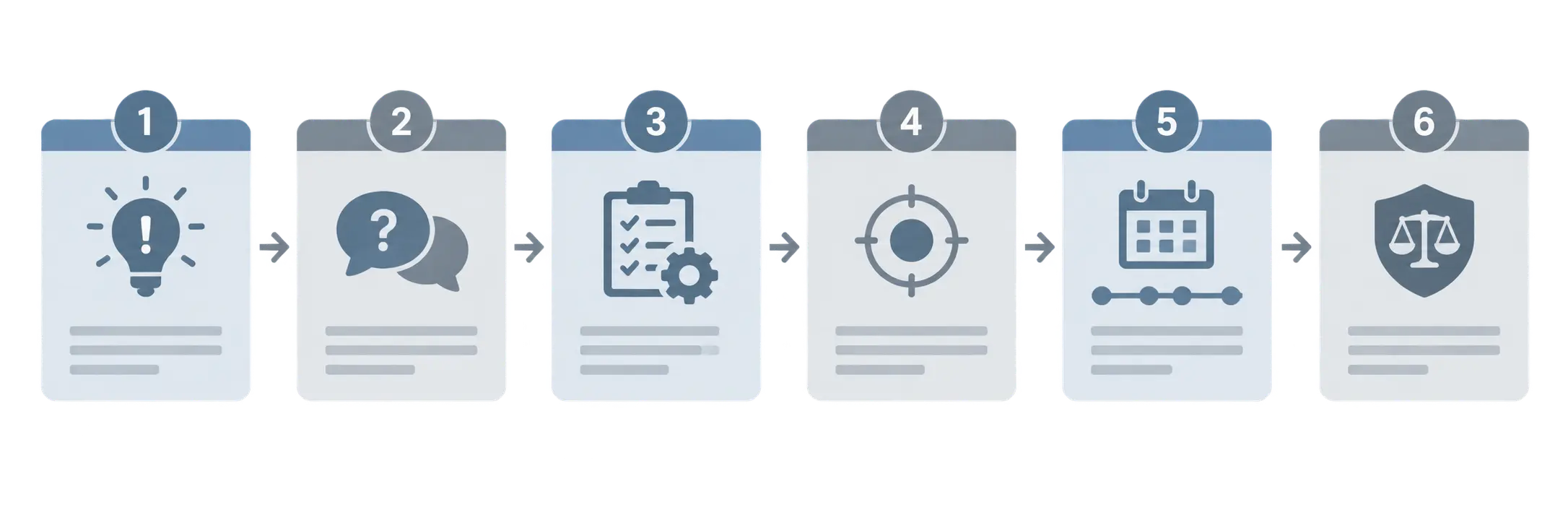
A business administration thesis proposal in Canada needs six sections your committee will actually check: a problem statement that names a real gap, research questions and objectives, a stated and justified methodology, a defined scope, a realistic timeline, and a short ethics note if you will collect data from people. Below is what goes in each one, with a worked example built around a fictional retail case.
What sections does a Canadian business administration thesis proposal need?
Most business schools structure the proposal around the same skeleton, even when the exact page count and formatting rules differ by faculty: a working title, a problem statement, research questions or hypotheses, a short review of the closest existing work, a methodology section, a scope statement, a timeline, and a references list. Some programmes fold the ethics note into the methodology section; others give it its own short paragraph. Check your own programme’s thesis or major research paper (MRP) handbook for the exact template — the content below covers what a committee is actually reading for inside each heading, which does not change even when the heading order does.
How do you write the problem statement for a business thesis?
A problem statement is not a topic. “Employee engagement in retail” is a topic; a problem statement says what is unresolved about it and why it matters to a specific audience. A workable pattern: name the phenomenon, cite the gap or tension in existing practice or literature, and state the consequence of leaving it unanswered.
Worked example (illustrative, not a real study): “Canadian mid-market grocery retailers have adopted flexible scheduling software over the past several years, marketed on the promise of higher frontline retention. Existing research on scheduling flexibility largely comes from US big-box settings and does not test whether the same effect holds in a unionised, mid-market Canadian context. Retailers making purchasing decisions about scheduling software currently have no Canadian-specific evidence to weigh against vendor claims.”
Notice what that paragraph does: it names a real practice, points to a specific gap in the literature (US big-box vs. Canadian mid-market), and states a concrete consequence (retailers deciding blind). A committee can approve or reject that in one read.
What do research questions and objectives look like in a business proposal?
Objectives are what you will do; research questions are what you will answer. Keep both to a small, testable set — two or three research questions is typical, more than four usually signals a proposal that has not been scoped yet. Following the retail example:
- RQ1: Does flexible scheduling software adoption correlate with frontline retention in unionised, mid-market Canadian grocery retail?
- RQ2: Which scheduling features (self-swap, advance notice, shift bidding) show the strongest association, if any?
- Objective: Test RQ1 and RQ2 using turnover records and a frontline survey from two to three participating store locations.
Which methodology should a business administration proposal commit to?
There is no default methodology for a business thesis, and naming one without justifying the fit is a common reason proposals stall. A useful way to think about the choice, drawn from Saunders’ widely used “research onion” framework in management research methods, is to work from philosophy down to technique: are you testing a relationship across many cases (usually a quantitative, often survey-based design), or explaining how or why something happens in one or a few settings (usually a qualitative case-study design, in the tradition associated with Robert Yin and, for theory-building case work, Kathleen Eisenhardt)? Mixed-methods designs, combining a survey with follow-up interviews, are also common in marketing and organisational-behaviour topics where a number alone will not explain the mechanism. Whichever you pick, the proposal has to say why that method answers your specific research question better than the alternative — a sentence naming the method is not a justification.
How long is a typical proposal, and what does your committee actually check?
There is no single Canadian standard for proposal length; it is set by your own faculty and often varies by whether your programme awards a thesis, an MRP, or a coursework-plus-project degree. What is consistent across programmes is what a committee is checking for, regardless of page count: a problem statement with a real, stated gap; research questions that are answerable with the proposed method inside your programme’s timeline; a methodology that is justified, not just named; and evidence that you have thought about access — to a company, a dataset, or a sample — rather than assumed it will appear.
A worked example: from topic to one-page proposal outline
Continuing the retail scheduling example, a condensed proposal outline might read:
| Working title | Flexible Scheduling and Frontline Retention in Canadian Mid-Market Grocery Retail |
| Problem | Vendor claims about scheduling software and retention are untested in a unionised, mid-market Canadian setting. |
| RQs | Does adoption correlate with retention? Which features drive it? |
| Method | Quantitative: turnover records + frontline survey, 2–3 participating stores |
| Scope | One grocery chain, Ontario locations, most recent fiscal year |
| Timeline | [illustrative, set to your own term dates] Ethics submission month 1, data collection months 2–3, analysis months 4–5, draft chapter month 6 |
| Ethics | REB submission required — employee survey with identifiable participants |
Do you need ethics approval for a business thesis?
If your study involves interviews, surveys, or observation of real people — including employees or managers at a company you name or anonymise — most Canadian business schools route that through their Research Ethics Board (REB) before data collection begins, under the same Tri-Council Policy Statement (TCPS 2) framework that governs research ethics review across faculties. A study built entirely on public filings, published datasets, or archival financial data typically needs a lighter review, sometimes none, but this is a programme-specific determination, not something to assume from the topic alone. Raise it with your supervisor while you are still drafting the proposal, since REB timelines can run several weeks and often set the real start date for data collection.
Common reasons a business administration proposal gets sent back
- The problem statement is a topic, not a gap. “I want to study employee engagement” states an interest, not an unresolved question.
- The method does not fit the question. A “how” or “why” question proposed as a large-sample survey, when only a small-sample case study can actually answer it (or the reverse).
- Access was assumed, not confirmed. A company case study proposed without even an informal indication that the company will grant access to staff, records, or a site.
- The scope is too large for the timeline. A cross-industry comparison proposed for a one-term MRP, where the realistic scope is a single firm or sector.
If your committee sends a proposal back, the note usually names one of these four issues directly — rewriting the problem statement or the method-question fit, rather than adding more literature, is almost always the actual fix.
Getting from outline to a full draft
Once your proposal is approved, the fastest path to the actual proposal document is expanding each line of the outline above into full paragraphs, with the same problem-statement discipline (name the gap, cite it, state the consequence) carried through the introduction chapter. If drafting that expansion from a blank page is the bottleneck, Tesify can help you turn an approved outline like the one above into full proposal prose you still review, edit, and take ownership of section by section — it drafts with you, it does not submit anything in your name. Check Tesify’s own pricing page for current plans rather than assuming a figure here.
For the sections that come immediately before and after the proposal stage, see how a thesis introduction chapter is built from an approved problem statement, and how to write problem statement examples across other Canadian disciplines. If your proposal is heading toward a case-study design, REB-ready survey and interview templates are a useful next stop, and how to write the methodology chapter covers what the proposal’s method section grows into. Political science and public health theses in Canada follow a similar research-questions structure, worked through in research questions and hypotheses for a political science thesis.
Frequently asked questions
What is a business administration thesis proposal?
It is a short document, usually 6 to 10 pages before your supervisory committee sees a full chapter, that states the business problem you plan to study, your research questions, the methodology you intend to use, and a realistic timeline. Its job is to get committee approval before you commit months to data collection.
How long should a business thesis proposal be?
Length is set by your own faculty and programme, not by a national standard. Many business schools ask for something in the 6 to 12 page range at proposal stage, longer once it becomes your first thesis chapter. Confirm the exact expectation in your programme’s thesis or MRP handbook.
Does a business proposal need a literature review?
Yes, but a short one. At proposal stage the literature review has to do one job: show the gap your problem statement is responding to, using five to ten well-chosen sources rather than an exhaustive survey. The full literature review chapter comes later.
What methodology do most business administration theses use?
There is no single default. Quantitative survey designs are common in marketing, finance, and organisational behaviour topics; qualitative case studies are common where the question is about how or why a specific firm or process works; some programmes accept a business-plan-as-thesis format instead. Your proposal has to justify the fit between your question and your chosen design, not just name a method.
Do I need ethics approval for a business thesis?
If you interview or survey real people, including employees or managers at a company, most Canadian business schools route that through their Research Ethics Board before you collect data, under the same TCPS 2 framework that applies across faculties. A pure secondary-data or archival study, using only public filings or datasets, typically needs a lighter review or none, but confirm this with your programme rather than assuming.
What is the most common reason a business proposal gets sent back?
A mismatch between the research question and the proposed method is a common reason: a question phrased as “why” or “how” paired with a survey design that can only measure correlation, or a question about one specific firm proposed as a large-sample survey. A second common reason is a problem statement that is really a topic, not a question with a stated gap.
Can I change my business thesis topic after the proposal is approved?
Minor scope changes are routine and usually need only your supervisor’s sign-off. A change to the research question, the company or sector studied, or the methodology is a bigger step that typically means a revised proposal back to your committee, so raise it with your supervisor as soon as you are considering it rather than after you have already changed direction.
What access do I need before I propose a company case study?
Before your proposal is approved, most committees expect at least an informal confirmation that a named company, or a realistic path to an anonymised equivalent, will actually give you access to the people or data you need. A proposal built around access you have not lined up is one of the more common causes of a stalled first term.
How is a business thesis proposal different from a business plan?
A business plan sets out how a venture will operate and make money. A thesis proposal sets out a research question you intend to answer using a defensible method, even where the topic is entrepreneurial. Some Canadian programmes do accept a business-plan-as-thesis format, but that is a distinct, named option your handbook will state explicitly, not the default reading of “proposal.”