
Forty pediatric nursing thesis topics, sorted into eight sub-areas, each phrased as a researchable question with a suggested design and the ethics review it will likely need. Pediatric nursing is a distinct sub-field from general nursing on every axis a committee checks: consent runs through a substitute decision-maker, assent from the child is its own separate step where developmentally appropriate, and outcome measures are age-banded rather than adult-standard. The topics below are scoped narrowly enough to defend in a proposal meeting, not broad restatements of “pediatric nursing” as a single subject.
Why a sub-field topic beats a general pediatric nursing topic
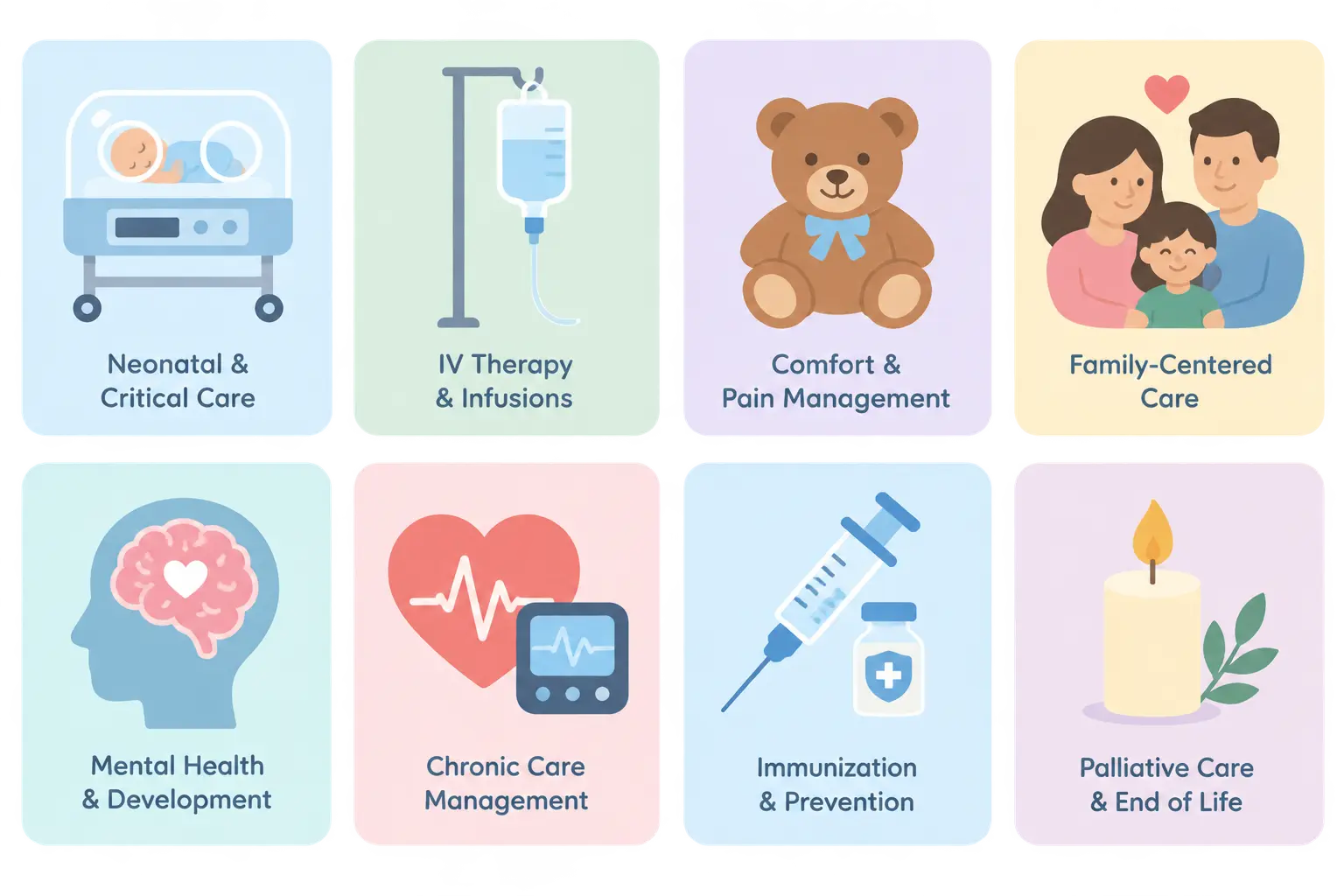
“Pediatric nursing” on its own is not a thesis topic; it is a discipline with dozens of active sub-literatures, and a committee reading a proposal scoped at that level usually asks for a narrower angle before approving it. The eight sub-areas below split the field the way the Canadian pediatric nursing literature itself is actually organised — neonatal/NICU care, oncology, procedural pain, family-centred care, mental health, chronic and complex care, immunization, and palliative care are each large enough to support a dedicated body of prior research you can build on, and narrow enough that your own contribution is identifiable rather than diluted across the whole field. Pick one sub-area first, then one of the five topics inside it, rather than trying to combine two sub-areas into a single first thesis.
Neonatal and NICU nursing (5 topics)
- How do NICU nurses assess and manage procedural pain in preterm infants who cannot self-report? Suggested design: qualitative interviews with NICU nurses, thematic analysis.
- What barriers do NICU nurses identify to consistent kangaroo care (skin-to-skin contact) implementation on a Canadian unit? Design: cross-sectional staff survey.
- How does parental presence during NICU rounds affect nurses’ reported workflow and communication? Design: mixed-methods, unit-level survey plus follow-up interviews.
- What is the relationship between NICU nurse-to-patient ratios and self-reported missed care events? Design: quantitative, cross-sectional survey with a validated missed-care instrument.
- How do NICU nurses support parents through a first skin-to-skin session after a prolonged separation? Design: qualitative case study, small sample.
Pediatric oncology nursing (5 topics)
- How do pediatric oncology nurses communicate a relapse diagnosis to school-age children, and what language do they use? Design: qualitative, semi-structured interviews.
- What self-reported compassion-fatigue levels do pediatric oncology nurses show compared to general pediatric ward nurses? Design: quantitative, comparative survey using a validated compassion-fatigue scale.
- How do siblings of a child with cancer describe their experience of hospital visits, and what role do nurses play in that experience? Design: qualitative interviews with siblings (age-appropriate consent/assent protocol required).
- What nursing interventions are most associated with reduced treatment-related anxiety in children undergoing chemotherapy? Design: literature-based intervention review plus a small observational pilot.
- How prepared do newly graduated nurses feel to manage a pediatric oncology emergency (e.g., febrile neutropenia)? Design: quantitative, self-efficacy survey.
Pediatric pain and procedural comfort (5 topics)
- Which non-pharmacological comfort measures do pediatric nurses use most often during routine blood draws, and why? Design: cross-sectional survey.
- How consistently is a validated pediatric pain scale (e.g., FLACC, Wong-Baker FACES) actually documented on a general pediatric ward? Design: retrospective chart audit.
- What do parents report about their child’s pain being under-treated during a hospital stay? Design: qualitative interviews with parents post-discharge.
- How does distraction technology (tablets, virtual reality) affect nurse-reported procedural distress in school-age children? Design: quasi-experimental pilot, before/after comparison.
- What training gaps do pediatric nurses identify in managing chronic pain in adolescents? Design: qualitative focus groups.
Family-centred care (5 topics)
- How do nurses on a general pediatric ward describe the practical limits of family-centred care during a busy shift? Design: qualitative interviews.
- What barriers do rural and remote Canadian families face in participating in family-centred care during a distant hospital admission? Design: qualitative interviews with families, purposive sample.
- Does a structured family-presence protocol during bedside rounds change parents’ reported satisfaction with communication? Design: quasi-experimental, pre/post survey.
- How do nurses adapt family-centred care approaches for a family with a language barrier and no in-person interpreter available? Design: qualitative case study.
- What do adolescent patients (rather than their parents) report wanting from family-centred care models designed mainly around younger children? Design: qualitative interviews with adolescents.
Pediatric mental health nursing (5 topics)
- How do pediatric medical-unit nurses (not psychiatric specialists) manage a child presenting with acute suicidal ideation while boarding for a psychiatric bed? Design: qualitative interviews.
- What screening tools are actually used at triage to identify pediatric mental health crises in a general emergency department? Design: retrospective chart review.
- How prepared do pediatric nurses feel to support a child with an eating disorder on a general medical unit? Design: quantitative self-efficacy survey.
- What is the lived experience of nurses caring for adolescents held under a mental health act on a general pediatric floor? Design: qualitative, interpretive phenomenology.
- How does a structured de-escalation training program change nurse-reported confidence in managing pediatric behavioural crises? Design: quasi-experimental, pre/post training survey.
Chronic illness and complex care (5 topics)
- How do nurses coordinate discharge teaching for a child newly diagnosed with type 1 diabetes and their family? Design: qualitative case study.
- What gaps exist in the transition of adolescents with cystic fibrosis from pediatric to adult care, from the pediatric nurse’s perspective? Design: qualitative interviews.
- How does caregiver burden among parents of medically complex children (technology-dependent, multiple specialists) relate to their reported use of respite services? Design: quantitative, cross-sectional survey.
- What nursing strategies best support medication adherence in adolescents managing a chronic illness independently for the first time? Design: literature review plus qualitative interviews with adolescents.
- How do school-based nurses manage the care plan for a child with a complex chronic condition during the school day? Design: qualitative interviews with school health nurses.

Immunization and preventive health (5 topics)
- What reasons do parents give pediatric nurses for vaccine hesitancy at a well-child visit in a Canadian primary care setting? Design: qualitative interviews with parents.
- How effective is a nurse-led motivational interviewing approach at changing parental vaccine intention? Design: quasi-experimental pilot.
- What is the relationship between public health nurse staffing levels and school-based immunization catch-up rates in a given region? Design: quantitative, ecological/correlational using regional data.
- How do nurses adapt immunization counselling for newcomer families with limited prior contact with the Canadian health system? Design: qualitative interviews.
- What do adolescents themselves understand about HPV vaccination when nurses deliver a school-based program? Design: quantitative, pre/post knowledge survey.
Pediatric palliative and end-of-life care (5 topics)
- How do pediatric nurses describe providing end-of-life care for a child while simultaneously supporting siblings present on the unit? Design: qualitative, interpretive phenomenology.
- What moral distress do pediatric nurses report when a family’s wishes conflict with the clinical team’s recommendation near end of life? Design: qualitative interviews.
- How is a pediatric palliative care consult typically timed relative to diagnosis for children with a life-limiting condition? Design: retrospective chart review.
- What bereavement support do nurses report offering families after a child’s death on a general (non-palliative) pediatric unit? Design: qualitative interviews.
- How do rural Canadian families access pediatric palliative care compared to urban families, from the referring nurse’s perspective? Design: qualitative interviews with referring nurses.
Choosing one of these as your actual thesis topic
A workable pediatric nursing topic needs three things a committee will check in the first meeting: a named sub-area (not “pediatric nursing” broadly), a design that matches the question (a “how” or “why” question needs qualitative or mixed methods, not a survey alone), and a realistic access plan for who you will actually recruit or which records you will actually review. Several of the topics above are deliberately built around chart review or staff/parent surveys rather than direct interviews with children, since access to pediatric patients as research participants involves an additional layer of ethics review beyond an adult-population study, and a first thesis is rarely the right project to take on the most complex consent pathway available.
Any topic touching children as participants, or data about children, goes through your institution’s Research Ethics Board under the Tri-Council Policy Statement (TCPS 2), which has a dedicated section on research involving children and, where a child lacks capacity to decide, requires consent from an authorized third party together with the child’s own assent where the child is able to give it. Raise your shortlist with your supervisor before you commit, since some of the mental-health and end-of-life topics above carry a longer ethics review timeline than a straightforward chart audit.
Access is worth scoping honestly before you fall in love with a topic. A NICU or oncology-unit topic usually means recruiting through a specific unit’s nurse manager and clearing that unit’s own research approval process on top of the institutional REB, which can add weeks; a chart-review or general staff-survey topic across a whole pediatric floor is often faster to get moving because it does not depend on one clinical area’s goodwill. Neither path is wrong, but knowing which one you are choosing before your proposal meeting avoids a stalled first term waiting on an access agreement nobody confirmed in advance.
From topic to proposal
Once your supervisor has approved a topic from this list, the next document is a full proposal: problem statement, research questions, methodology, and a realistic timeline that accounts for REB review time. If turning an approved topic into full proposal prose is where you are stuck, Tesify can help you draft that expansion section by section, work you still review and take ownership of — it does not submit anything in your name. Check Tesify’s own pricing page for current plans.
For the next steps after a topic is chosen, a complete nursing thesis example shows the full section-by-section shape a finished thesis takes, and which burnout scale to use in a nursing thesis is a direct next stop if your topic touches nurse wellbeing. How to write a systematic-review thesis in nursing is the right companion piece if you would rather synthesise existing pediatric literature than collect new data, and the site’s general nursing thesis topics list covers the wider field if none of the 40 above fit your program’s scope.
Frequently asked questions
What makes a pediatric nursing thesis topic different from a general nursing topic?
A pediatric-specific topic accounts for consent by a substitute decision-maker, assent by the child where developmentally appropriate, family-centred care models, and age-banded clinical measures, none of which a generic adult-nursing topic has to address.
Do pediatric nursing thesis topics need REB approval?
Any topic involving data from or about children, including chart review or staff surveys about pediatric patients, is reviewed by your institution’s Research Ethics Board under the Tri-Council Policy Statement (TCPS 2), which has a dedicated section on research involving children and requires third-party consent plus the child’s assent where the child can give it. Confirm the exact review track with your supervisor before finalising a topic.
Can I do a pediatric nursing thesis without direct patient contact?
Yes. Several topics above use chart review, staff or parent surveys, or secondary analysis of existing data, which avoid direct clinical contact with child participants while still producing pediatric-specific findings.
What is the most common reason a pediatric nursing topic gets sent back?
A topic scoped at the general nursing level rather than a specific pediatric sub-area (a named age band, unit type, or condition) is the most common reason a committee asks for a narrower topic, since general topics are usually already well covered in the literature.
How many participants does a pediatric nursing thesis usually need?
There is no fixed number; it depends entirely on the design. A qualitative study with parents or nurses might need 10 to 15 interviews to reach saturation, while a quantitative chart review might use several hundred records. Your methodology course and supervisor set the actual target for your specific design.
Is family-centred care still a valid pediatric nursing thesis topic in 2026?
Yes, particularly when scoped to a specific unit type, family structure, or barrier (language, geography, shift-work schedules) rather than treated as a single generic topic, since the broad family-centred-care literature is already large.